On this page
- The 2026 Transport Landscape: What’s New and Why It Matters
- T-Money: The Foundation of Everything
- The GTX-A: Seoul’s Underground Express
- KTX: High-Speed Rail Between Cities
- KTX-Eum: The Coastal Line That Changes East Coast Travel
- KTX-Cheongnyong: The Fastest Train in Korea
- Choosing Your Pass: Climate Card vs K-Pass vs Standard T-Money
- The Climate Card: Best for Short Seoul Stays
- The K-Pass: Best for Nationwide and Longer Stays
- Getting from Incheon Airport into Seoul: Every Option Compared
- Intercity Travel Beyond KTX: Buses, Ferries, Domestic Flights
- Booking KTX Tickets: Apps, Seats, and How Not to Get Stranded
- Taxis and Ride-Hailing in 2026
- Cycling and Micro-Mobility in Korean Cities
- Transport Costs: 2026 Budget Reality
- Common Transport Mistakes to Avoid
- Frequently Asked Questions
- Navigation Apps for Getting Around Korea
South Korea has the best public transport system in Asia. That’s not a tourism board talking point — it’s a practical reality you’ll feel the moment you tap through an Incheon Airport subway gate and arrive in central Seoul 43 minutes later for less than $4. In 2026, that system just got significantly better. The GTX-A is running. The KTX-Eum coastal line is open. The K-Pass nationwide refund system has been overhauled. Travel times that used to define what was and wasn’t possible on a two-week Korea trip have been slashed to the point where the entire country is smaller than it looks on a map.
The catch: none of this is intuitive if you arrive without a plan. There are three different transit passes, multiple rail systems that look the same but aren’t, booking apps that only work if you’ve registered in advance, and a handful of traps — like the Climate Card not working on the GTX — that will cost you money and time if you hit them unprepared. This guide covers all of it.
The 2026 Transport Landscape: What’s New and Why It Matters
The map you used in 2024 is out of date. Three things changed the Korean transport picture in the 18 months to March 2026:
- GTX-A went operational in two segments — connecting Goyang/Paju in the northwest to Seoul Station, and Dongtan in the south to Suseo in southeastern Seoul. What used to be 50+ minute suburban slogs are now 16–20 minute underground blasts at 190 km/h.
- KTX-Eum launched on the east coast — the first high-speed rail line running along Korea’s eastern seaboard, connecting Busan directly to Gangneung without going through Seoul. A coastal journey that took five hours by bus now takes under four hours by train, with sea views the whole way.
- The All-K-Pass launched in January 2026 — removing the usage cap on the K-Pass refund system and making it genuinely useful for anyone spending more than about two weeks in Korea.
The result is a country where Seoul to Busan is 2 hours 10 minutes, Goyang to central Seoul is 16 minutes, and the entire east coast from Busan to the Gangwon ski resorts is connected by a single rail line for the first time. For a traveller in 2026, this changes the geometry of what’s worth doing — destinations that weren’t realistic as day trips from Seoul now are, and the old assumption that you need a car to properly see regional Korea is less true than ever.
T-Money: The Foundation of Everything

Before getting into passes and rail networks, understand T-Money — because it underpins all of it. T-Money is Korea’s contactless transit payment system: a stored-value card (or digital equivalent) you tap at subway gates, bus card readers, and taxi payment terminals. It works on every subway line in every Korean city, every intercity bus, most taxis, and a growing number of non-transit merchants.
You need T-Money access from the moment you arrive. There’s no scenario where you visit Korea in 2026 and don’t use it. The question is just which form it takes:
- Physical T-Money card — available at convenience stores (GS25, CU, 7-Eleven) and subway station vending machines. The standard option. Costs 2,500–4,000 KRW for the card; load it with whatever amount you want.
- WOWPASS T-Money balance — if you’re using WOWPASS as your tourist payment card (which you should be), it includes a built-in T-Money balance on the same card. One card for transit and everyday spending.
- Apple Pay T-Money Express — since late 2025, iPhone and Apple Watch users can add T-Money to their Wallet and tap at subway gates without unlocking the device. Works on Seoul and Busan metro, most city buses. Setup takes five minutes; instructions in the Payments guide.
- Samsung Pay T-Money — native integration on Samsung devices, same functionality as Apple Pay version.
One important T-Money rule that catches tourists out: transferring between subway and bus within 30 minutes costs nothing extra (or a small supplement on longer distance transfers). This is the Korean transit discount system — tap on the bus within 30 minutes of tapping off the subway, and the fare is heavily discounted. It only works with T-Money or equivalent. Single-journey paper tickets don’t get the transfer discount. This alone is a reason to get T-Money before your first journey, not after.
Loading and Topping Up
Top up at any subway station vending machine (cash or card), any convenience store counter, or via the WOWPASS app if your T-Money is on WOWPASS. The Apple Pay and Samsung Pay T-Money balances top up via the respective Wallet apps using any linked card. There’s no minimum load amount — you can add ₩5,000 at a time if you want, though loading ₩30,000–₩50,000 at the start of a multi-day stretch in Seoul means you’re not hunting for a top-up machine mid-day.
The GTX-A: Seoul’s Underground Express
The GTX-A (Great Train eXpress Line A) is the most significant change to Seoul’s transit network in a decade. It runs in deep underground tunnels — 40–50 metres below street level, bypassing the surface congestion that slows regular subway trains — at speeds up to 190 km/h. It’s not replacing the regular subway; it’s a parallel express layer that covers the same geography in a fraction of the time.
What’s Running in March 2026
The GTX-A is operational in two segments:
- Northern segment: Unjeong Central (Paju) → Daegok → KINTEX (Goyang) → Seoul Station. KINTEX to Seoul Station takes 16 minutes. Previously 50+ minutes by regular subway.
- Southern segment: Suseo (southeastern Seoul) → Guseong → Seongnam → Dongtan. Connects Pangyo and the Bundang tech corridor to Seoul’s eastern subway network.
The full GTX-A connection between Unjeong and Dongtan — running north to south through central Seoul — is still under construction for the central section. The two operating segments are functional end-to-end but don’t yet connect to each other through Seoul’s core. That full connection is expected later in 2026.
Who Should Care About the GTX-A
As a tourist, the GTX-A is most useful in one specific scenario: accommodation strategy. Hotels in central Seoul (Myeongdong, Hongdae, Gangnam) are expensive, particularly during peak season. Hotels in Goyang and Paju — which are effectively suburban satellite cities northwest of Seoul — are significantly cheaper and now genuinely convenient. KINTEX to Seoul Station in 16 minutes at GTX speeds means you can stay somewhere like Goyang, pay half the room rate, and be in Insadong within 25 minutes door-to-door.
KINTEX itself — the Korea International Exhibition Center — also hosts major concerts and events. If you’re coming to Korea for a K-Pop concert or exhibition, the GTX-A makes KINTEX accessible from central Seoul without the previous taxi-or-give-up situation.
GTX-A Fares and Pass Compatibility
GTX-A fares are higher than regular subway fares — roughly ₩3,000–₩4,500 per journey depending on distance, versus ₩1,400–₩1,600 for a standard subway trip. Pay with T-Money or K-Pass. The Climate Card does not cover GTX-A journeys — this is the most important GTX trap for tourists. If you tap through a GTX gate with a Climate Card expecting it to be covered, it won’t work. Use T-Money balance or K-Pass instead.
KTX: High-Speed Rail Between Cities

The KTX (Korea Train Express) is Korea’s high-speed rail network and the backbone of intercity travel. Seoul to Busan. Seoul to Daejeon. Seoul to Gwangju. Seoul to Gangneung. These journeys, which by bus or older train would take four to six hours, collapse to two to three hours on KTX. For any trip covering more than one Korean city, KTX is almost always the right choice over buses or domestic flights once you factor in check-in times and transport to/from airports.
All KTX trains depart from Seoul Station or Suseo Station (SRT trains — a separate but similar high-speed service operated by a different company, SR). Seoul Station handles most KTX routes; Suseo handles SRT, which serves the Gyeongbu line (Seoul–Busan) and Honam line (Seoul–Gwangju/Yeosu) as an alternative to KTX on those routes, often with seats available when KTX is sold out.
Key KTX Routes and Journey Times (2026)
- Seoul → Busan: 2 hours 10 minutes (KTX-Cheongnyong, express) / 2 hours 40 minutes (standard KTX)
- Seoul → Daejeon: 50 minutes
- Seoul → Gwangju (Songjeong): 1 hour 40 minutes
- Seoul → Gyeongju (Singyeongju): 2 hours
- Seoul → Gangneung: 1 hour 55 minutes
- Seoul → Jeonju: 1 hour 10 minutes (KTX Honam line)
- Busan → Gangneung (KTX-Eum coastal line): 3 hours 50 minutes
KTX has two classes: Standard and First Class (Special). Standard class is already comfortable — wide seats, decent legroom, power outlets at most seats in newer trains. First Class adds more space and a meal service on some routes. Most travellers stick with Standard unless they’re on a long journey and want the extra comfort.
KTX-Eum: The Coastal Line That Changes East Coast Travel
The KTX-Eum is the newest and most visually dramatic addition to Korea’s rail network. Launched in late 2025 and now running at full schedule, it connects Bujeon Station in Busan directly to Gangneung on the east coast — the first high-speed rail line to run along Korea’s eastern seaboard without routing through Seoul.
Before this line existed, travelling the East Coast of Korea by public transit meant either taking a bus (slow, multiple transfers) or routing back through Seoul to pick up the Seoul–Gangneung KTX, adding hours to what should be a straightforward coastal journey. The KTX-Eum fixes this completely.
The Route
Bujeon (Busan) → Ulsan → Pohang → Gyeongju → Andong → Yeongju → Gangneung. The tracks run along and near the coast for significant stretches — particularly between Pohang and the northern sections — making this one of the few Korean train journeys where the view outside the window is genuinely worth watching. Travel time Busan to Gangneung: 3 hours 50 minutes. Previous best by bus or slow train: around 5 hours.
Why This Changes East Coast Trip Planning
The east coast — Pohang, Gyeongju, the beaches of Gangwon Province, Sokcho — was always worth visiting but logistically awkward from Busan. Now it’s a linear rail journey. The itinerary that used to require either a car or a complicated series of bus transfers is now straightforward: Busan by KTX from Seoul, then north along the coast by KTX-Eum, stopping at Gyeongju, Pohang, or Gangneung as your trip unfolds. Gangneung connects directly to Seoul via the existing Seoul–Gangneung KTX, making a complete loop possible without backtracking.
For anyone building a Korea itinerary beyond Seoul and Busan in 2026, the KTX-Eum is the route to know about.
KTX-Cheongnyong: The Fastest Train in Korea

The KTX-Cheongnyong (“Blue Dragon”) is the flagship of the 2026 KTX fleet — Korea’s fastest commercial train at 320 km/h and the one responsible for the 2 hour 10 minute Seoul–Busan time. It operates primarily on the Gyeongbu Line (Seoul–Daejeon–Daegu–Busan) and the Honam Line (Seoul–Gwangju), making fewer stops than standard KTX services and maintaining higher average speeds as a result.
The difference between a Cheongnyong service and a standard KTX on the same route is typically 25–35 minutes — meaningful on a 2-hour journey, less so if you’re only going Seoul to Daejeon. Check whether the specific service you’re booking is a Cheongnyong or standard KTX in the Korail app — it’s shown in the train type field. Cheongnyong services are also the most likely to sell out first on popular routes.
SRT: The Other High-Speed Option
The SRT (Super Rapid Train) is operated by a separate company (SR, not Korail) but runs on the same tracks as KTX on the Gyeongbu and Honam lines. It departs from Suseo Station in southeastern Seoul rather than Seoul Station. If you’re staying in Gangnam, Songpa, or anywhere in southeastern Seoul, Suseo is significantly more convenient than Seoul Station. Fares are slightly cheaper than KTX on comparable routes. The trains themselves are essentially identical in quality to modern KTX rolling stock.
Booking SRT requires a separate app or website from KTX — the SRT app or srail.kr. You can’t book SRT through Korail Talk. If KTX is sold out on a route you need, check SRT availability — they often have seats when the Korail system shows nothing.
Choosing Your Pass: Climate Card vs K-Pass vs Standard T-Money
This is where most guides either oversimplify or bury the answer in caveats. Here’s the clean version: which pass you want depends entirely on how long you’re staying and where you’re going.
- 1–7 days, mostly Seoul: Climate Card (short-term tourist version)
- 10+ days, travelling between cities: K-Pass (All-K-Pass tier)
- Short visit, only a few transit trips per day: Standard T-Money, pay as you go
The detailed breakdown of each follows — but if you want the one-line answer before reading further: get a WOWPASS (which includes T-Money) at the airport regardless. From there, decide whether to upgrade to a Climate Card or K-Pass based on your itinerary.
The Climate Card: Best for Short Seoul Stays

The Seoul Climate Card (기후동행카드) is an unlimited transit pass for Seoul’s subway and bus network. You pay a flat fee upfront and ride as many times as you want within the validity period. Simple, cheap, and genuinely good value if you’re moving around Seoul regularly.
2026 Pricing
- 1 day: ₩5,000 (~$3.70 USD)
- 3 days: ₩10,000 (~$7.40 USD)
- 7 days: ₩20,000 (~$14.80 USD)
- 30 days: ₩65,000 (~$48 USD)
A single Seoul Metro journey costs ₩1,400–₩1,600. If you’re taking four or more trips a day, the 3-day card pays for itself on day one. The 7-day card breaks even at about two and a half trips per day — achievable on any day you’re actually out exploring.
What the Climate Card Covers
- All Seoul Metro lines (1–9, Bundang, Shinbundang — wait, see below)
- Seoul city buses (blue, green, red express within Seoul city limits)
- Ttareungyi public bike-sharing (unlimited 1-hour rides)
- Some Han River ferry routes
Critical Exclusions — Know These Before You Tap
- GTX-A: Not covered. You’ll be rejected at the gate.
- Sinbundang Line (Line 8 extension to Gangnam): Not covered. This line — popular for getting to Gangnam and Pangyo — requires T-Money payment even if you have a Climate Card.
- AREX Airport Express: Not covered. Incheon Airport to Seoul Station requires a separate fare.
- Gyeonggi Province extensions: Routes that extend outside Seoul city limits require a T-Money top-up for the portion outside Seoul. The Climate Card covers the Seoul portion; you pay for the rest.
- KTX and all intercity trains: Not covered. Separate tickets required.
How to Get the Climate Card
From March 2026, the short-term tourist versions (1, 3, and 7-day) are available at Seoul Metro station ticket offices and, as of March 17 2026, can be purchased at subway kiosks using overseas Visa and Mastercard — though the 3.7% foreign card service fee applies. Buying via WOWPASS app or topping up using your WOWPASS card avoids that fee. The 30-day version is available at subway station offices with passport.
The K-Pass: Best for Nationwide and Longer Stays
The K-Pass (and its 2026 upgrade, the All-K-Pass / Everyone’s Card) works differently from the Climate Card. Instead of paying upfront for unlimited rides, you pay per journey as normal and receive a government refund at the end of the month based on how many trips you took. The more you ride, the higher your refund percentage.
How the Refund System Works
- Use public transit 15–40 times in a month: receive a 20% refund on those fares
- Use transit 41–60 times: receive a 30% refund
- Use transit 61+ times: receive a 53% refund
The All-K-Pass / Everyone’s Card tier, launched January 2026, adds a hard cap benefit: once your monthly transit spending exceeds ₩62,000, everything beyond that threshold is 100% refunded. This means heavy transit users — digital nomads, long-term visitors, people doing a nationwide itinerary — effectively have their transit spending capped at ₩62,000 per month regardless of how much they ride.
What K-Pass Covers
Unlike the Climate Card, K-Pass works nationwide — Seoul Metro, Busan Metro, Daegu Metro, Gwangju Metro, intercity buses, and importantly, the GTX-A. The refund applies to all these journeys. If you’re spending time in multiple cities or using the GTX regularly, K-Pass is considerably more useful than the Seoul-only Climate Card.
Who Can Get a K-Pass
The standard K-Pass is officially designed for Korean residents with an Alien Registration Card (ARC). The All-K-Pass / Everyone’s Card is specifically the tier accessible to a broader range of users including those on longer-stay visas like the F-1-D Digital Nomad Visa. Short-term tourists on a 90-day tourist stamp aren’t officially eligible for the standard K-Pass refund system.
In practice: if you’re on a trip of two weeks or less, the Climate Card covers your Seoul transit and standard T-Money covers everything else — K-Pass isn’t worth the registration process for that duration. If you’re on an extended stay (30+ days) on an eligible visa, the All-K-Pass is worth setting up through the T-Money GO app and registering with your visa details.
Getting from Incheon Airport into Seoul: Every Option Compared

This is the first transit decision of any Korea trip, and it’s worth knowing all the options rather than just defaulting to whatever the hotel reception tells you to take.
AREX — Airport Railroad Express
The default choice for most travellers, and often the right one. Two services:
- Direct Train (Express): Incheon T1 or T2 directly to Seoul Station, no stops. 43 minutes, ₩11,000 (~$8.15 USD). Seats reserved (book at the airport station or via the AREX website). Runs 05:20–24:00.
- All-Stop Service (Commuter): Incheon T1 or T2 to Hongik University Station via nine intermediate stops. 51 minutes to Hongik, ₩4,950 (~$3.70 USD). No reservation needed, T-Money accepted. Runs same hours.
The all-stop service is the better choice for most tourists — ₩4,950 is a low price for a reliable 51-minute connection to Hongdae, which connects to Lines 2, 6, and the Gyeongui-Jungang line for onward connections. If you’re staying near Seoul Station specifically (and some good budget hotels are), the direct train at ₩11,000 makes sense. For anywhere else in Seoul, the all-stop service and one metro transfer is usually just as fast door-to-door and less than half the price.
Airport Limousine Bus
Coach buses running from Incheon directly to specific hotel areas and neighbourhoods across Seoul. Routes cover Myeongdong, Gangnam, Hongdae, Insadong, and many others. The advantage over AREX: if the route serves your specific area, it drops you closer to your accommodation without metro transfers. The disadvantage: Seoul traffic. Journey times range from 60 minutes at 6am to 2+ hours during peak hours. Cost: ₩10,000–₩18,000 depending on route. Book at the ground floor bus information desk at Arrivals or via the Airport Limousine website.
Use the limousine bus if: you have heavy luggage, you’re arriving off-peak (late night or early morning), and your destination is on a direct route. Avoid it if you’re arriving between 7am–9am or 5pm–8pm on a weekday — Seoul traffic turns a 70-minute journey into a 2-hour one.
Taxi and Ride-Hailing
Taxis from Incheon to central Seoul cost ₩65,000–₩90,000 (~$48–$67 USD) depending on destination and traffic. Not a budget option, but reasonable split between three or four people with heavy luggage at 2am. Use Kakao T (app) to book at the designated taxi area at Arrivals — this gives you a metered fare rather than a negotiated one, and Kakao T shows the estimated total before you confirm.
Don’t Forget Terminal 2
Incheon has two terminals connected by a free shuttle train (18 minutes). Terminal 2 handles Korean Air, Delta, Air France, and KLM. All other carriers use Terminal 1. If you’re flying Korean Air and looking up AREX from Terminal 1 — you’re at the wrong terminal. Both terminals have their own AREX stations and bus stops; the information applies identically at both.
Intercity Travel Beyond KTX: Buses, Ferries, Domestic Flights
KTX doesn’t go everywhere. For destinations off the rail network — and there are plenty of worthwhile ones — buses, ferries, and domestic flights fill the gaps.
Express Intercity Buses
Korea’s intercity bus network is extensive, comfortable, and often the only direct option to smaller cities. Buses run from Seoul Express Bus Terminal (Gangnam-gu) to virtually every city and town in Korea. Premium buses (Premia class) have reclining seats and individual screens; standard express buses are fine for journeys under three hours.
Key routes where buses beat or match KTX:
- Seoul → Sokcho: No KTX. Express bus from Dong Seoul Terminal takes 2.5–3 hours (~₩22,000). The fastest option to the east coast’s best beach town.
- Seoul → Chuncheon: ITX-Cheongchun train (not KTX but fast) or bus — both around 80 minutes.
- Seoul → Yeosu: KTX exists but expensive; express bus is slower but cheaper for budget travellers.
- Busan → Tongyeong / Geoje: No rail. Buses are the only option — 1.5–2 hours, scenic coastal routes.
Book buses via the T-Money GO app or at the terminal ticket counter. The app shows real-time seat availability and lets you select your seat. Unlike KTX, bus tickets rarely sell out more than a day or two in advance except on major national holidays (Chuseok, Seollal, Golden Week).
Domestic Flights
Domestic flights in Korea are worth considering for one specific route: Seoul (Gimpo) to Jeju. This is one of the busiest air routes in the world, with flights every 15–20 minutes from early morning to late evening. Journey time is 1 hour. Fares on budget carriers (Air Busan, Jeju Air, T’way) can be as low as ₩30,000–₩50,000 one way if booked ahead, though ₩80,000–₩120,000 is more typical with reasonable advance booking.
For all other domestic routes, KTX is faster than flying once you factor in check-in time, the Gimpo Airport commute, and baggage collection on arrival. Seoul to Busan by KTX-Cheongnyong (2 hours 10 minutes, city centre to city centre) is meaningfully faster than the equivalent flight (1 hour flight + 1.5 hours of airport overhead each end).
Ferries
Coastal and island ferry routes are an underused part of Korea’s transport network. Key routes:
- Incheon → Baengnyeongdo / western islands: Day ferries from Incheon Ferry Terminal
- Mokpo → Jeju: Overnight ferry, 12 hours. A different experience from flying — deck space, cabins, the slow version of Jeju arrival.
- Busan → Fukuoka (Japan): International — the Beetle or Camellia Line high-speed ferry, 3 hours. A practical option for Korea-Japan combination trips.
- Coastal island routes: Hundreds of small island ferries off the south and west coasts — Hallyeohaesang National Park island routes, Hongdo, Heuksando.
Booking KTX Tickets: Apps, Seats, and How Not to Get Stranded

KTX tickets can be bought at the station, but don’t. Or at least, don’t assume you can on the day you want to travel. Here’s the booking reality in 2026.
Korail Talk App (KTX)
The Korail Talk app is the official Korail booking platform and the one to use for KTX. Download it before you arrive in Korea. The English interface covers all booking functions: search by route and date, select seats, pay with international Visa or Mastercard, and receive a QR code ticket on your phone. No printing required — the QR code gets scanned by train staff or at automated gates.
Registration requires an email address and phone number. International phone numbers work for registration. Set up the account before departure from home, not at Seoul Station 20 minutes before your train.
SRT App
Separate app for SRT trains from Suseo Station. Same functionality as Korail Talk, separate registration. Check both systems if you’re travelling on the Gyeongbu (Seoul–Busan) or Honam (Seoul–Gwangju) lines — if KTX is sold out, SRT often has availability on the same route at comparable times.
When to Book
- Weekday travel: 3–7 days ahead is usually fine for most routes. Midweek (Tuesday–Thursday) rarely sells out completely.
- Weekend travel: 1–2 weeks ahead for popular routes (Seoul–Busan, Seoul–Gangneung). Friday evening and Sunday afternoon departures fill fastest.
- KTX-Eum (coastal line): 2 weeks ahead minimum for weekends — this is a new route with high demand and limited rolling stock.
- National holidays (Chuseok, Seollal, Golden Week): Book the moment tickets open — typically 1 month in advance. Trains sell out completely within hours of release on these dates. If you miss the window, check for cancellations daily; they appear regularly.
Seat Selection
KTX seats are in a 2+2 layout in Standard class. Window seats are A and D; aisle seats are B and C. If you care about the view on scenic routes — particularly Seoul–Gangneung through the mountains, or the KTX-Eum coastal sections — window seats on the sea side (east-facing on the southbound KTX-Eum) are worth selecting deliberately. The Korail app shows the seat map at booking; takes 30 seconds to choose the right position.
Taxis and Ride-Hailing in 2026
Taxis in Korea are cheap by Western standards, reliable, and increasingly easy to use for travellers without Korean language skills. The 2026 updates make them more tourist-friendly than ever.
Kakao T: The App to Use
Kakao T is Korea’s dominant ride-hailing app — think of it as the Korean Uber, except most of the drivers are licensed taxi drivers rather than private individuals. In 2026, Kakao T fully supports international phone numbers and overseas credit cards for auto-payment, meaning you can book, ride, and pay entirely through the app without cash or a Korean bank account.
How to use it: download Kakao T, register with your international phone number, add an international Visa or Mastercard for auto-payment, and you’re set. Enter your destination in English (or paste from Google Maps/Naver Maps) — the app geocodes it to the Korean address automatically. The driver sees the destination on their screen in Korean; you don’t need to communicate the address verbally.
Taxi Types and Fares
- Regular Taxi (일반택시): Silver or white cars. Base fare ₩4,800 (~$3.60 USD) in Seoul, metered from there. Most trips within central Seoul come to ₩8,000–₩15,000.
- International Taxi (국제택시): Black cars with multilingual drivers. Base fare higher (~₩7,000), but drivers speak English (and often Chinese or Japanese). Better experience for complex destinations or late-night travel when communication matters. Book via Kakao T or the International Taxi website.
- Kakao Black (Kakao T premium): Equivalent to Black Car/Uber Black. Sedan or SUV, higher fare, available through the Kakao T app.
Late night surcharge (midnight–4am): 20% added to the metered fare. Worth knowing if you’re getting back from a Hongdae night out.
Payment in Taxis
If you book via Kakao T with auto-pay registered, the fare is charged to your card automatically when you exit — no cash, no terminal interaction. For taxis hailed on the street, payment options vary by car: newer taxis have NFC terminals that accept T-Money and Apple Pay; older ones accept T-Money tap or card insertion; all accept cash. The safest fallback for street-hailed taxis is your WOWPASS T-Money balance.
Cycling and Micro-Mobility in Korean Cities

For short hops within a neighbourhood or along Seoul’s Han River parks, cycling is both practical and genuinely enjoyable in 2026.
Ttareungyi: Seoul’s Public Bike Share
Seoul’s public bike-sharing system has over 2,600 stations across the city. Bikes are available 24/7 via the T-Money GO app or the Ttareungyi app. Rates: ₩1,000 for the first hour, ₩1,000 for each additional hour. If you have a Climate Card, you get unlimited 1-hour rides included — one of the underappreciated benefits of that pass. The Han River path network is the most popular cycling route: a flat, car-free riverside trail stretching across the city with bike paths connecting major parks.
Electric Scooters
Kakao T Bike, Beam, and Lime all operate electric scooter share in Seoul and other major cities. All apps work with international cards and phone numbers. Rates are around ₩200 per minute after an unlock fee. Helmets are technically required by Korean law; rental scooters have them attached but enforcement is light. Useful for short distances in tourist areas; less useful in areas with heavy pedestrian traffic where scooters need to slow constantly.
Rental Bikes for Day Trips
In regional cities and tourist destinations — Gyeongju, Jeju, the Nami Island area — private bike rental shops near train stations and tourist sites offer day rentals for ₩5,000–₩15,000 depending on bike type. Gyeongju is particularly good for this: the entire historic core (Bulguksa, the burial mounds, the palace pond) is a 12km loop that’s best covered by bike rather than taxi or on foot. Electric bikes are increasingly available at these rental spots for the same reason they’re popular everywhere: you get the scenic ride without arriving at every hill sweaty.
Transport Costs: 2026 Budget Reality
Korea is remarkably cheap for getting around compared to Western Europe, Australia, or North America. Here’s what actual transport spending looks like across different trip types:
Seoul Only (7 Days)
- 7-day Climate Card: ₩20,000 (~$14.80 USD) — covers all subway and bus
- Airport AREX all-stop x2 (arrival + departure): ₩9,900 (~$7.35 USD)
- Taxis (a few late nights): ₩30,000–₩50,000 (~$22–$37 USD)
- Total: approximately ₩60,000–₩80,000 (~$44–$59 USD)
Seoul + Busan + Gyeongju (10 Days)
- Airport AREX x2: ₩9,900 (~$7.35 USD)
- Seoul–Busan KTX x2 (return): ₩120,000–₩140,000 (~$89–$104 USD)
- Busan–Gyeongju KTX x1: ₩12,000–₩15,000 (~$9–$11 USD)
- T-Money for city transit (Seoul + Busan + Gyeongju): ₩40,000–₩60,000 (~$30–$44 USD)
- Taxis: ₩30,000–₩50,000
- Total: approximately ₩210,000–₩275,000 (~$156–$204 USD)
Full Country Route: Seoul + East Coast + Busan + Jeju (2.5 Weeks)
- Airport AREX x2: ₩9,900
- Seoul–Gangneung KTX x1: ₩27,600 (~$20 USD)
- Gangneung–Busan KTX-Eum x1: ₩45,000–₩55,000 (~$33–$41 USD)
- Busan–Seoul KTX x1: ₩60,000–₩70,000 (~$44–$52 USD)
- Seoul–Jeju flight (Jeju Air): ₩50,000–₩100,000 (~$37–$74 USD)
- Jeju–Seoul flight: ₩50,000–₩100,000
- City transit + taxis: ₩80,000–₩120,000
- Total: approximately ₩320,000–₩470,000 (~$237–$348 USD)
Common Transport Mistakes to Avoid

Mistake 1: Using the Climate Card on the GTX-A
The most expensive rookie mistake in 2026. The GTX-A gate will reject a Climate Card, and if you’re trying to make a timed connection at Seoul Station, this is a stressful situation. Keep T-Money balance loaded as a backup even when you have a Climate Card.
Mistake 2: Not Booking KTX Until the Day Before
Fine on a Tuesday to Daejeon. A problem on a Friday to Busan. The KTX-Eum in particular is new and in high demand — weekend seats on that line go quickly. Book intercity trains as soon as your dates are fixed.
Mistake 3: Going to the Wrong Seoul Station
Seoul has multiple stations with “Seoul” in the name — Seoul Station (KTX, AREX, Lines 1 and 4), Suseo Station (SRT), and various suburban stations. SRT from Suseo and KTX from Seoul Station serve some of the same destinations. Know which one your ticket is for before you leave your accommodation, not while you’re in a taxi.
Mistake 4: Taking an Airport Limousine Bus During Rush Hour
The AREX takes exactly 51 minutes to Hongdae regardless of traffic. The airport limousine bus takes 60–120 minutes depending on when you travel. If you arrive during peak hours (7–9am, 5–8pm weekdays), AREX is always the right choice. The bus makes sense only for late night arrivals or if you have heavy luggage and a direct route.
Mistake 5: Forgetting the Transfer Discount
Tapping off the subway and then walking five minutes to a bus and tapping on within 30 minutes costs almost nothing extra — the transfer discount reduces the bus fare to nearly zero. Paying a separate full subway fare because you didn’t know this exists adds up over a week. Make sure you’re using T-Money (not a paper single-journey ticket) to get the transfer discount automatically.
Frequently Asked Questions
Does the Seoul Climate Card cover the AREX from Incheon Airport?
No. The Climate Card does not cover AREX — either the express direct train or the all-stop commuter service. You pay the AREX fare separately using T-Money or a single-journey ticket at the airport station. The Climate Card only activates for Seoul Metro and city buses within Seoul. Plan for ₩4,950 (all-stop) or ₩11,000 (direct) per direction for airport transit, on top of whatever transit pass you’re using in the city.
Can tourists use the K-Pass on a 90-day tourist stamp?
Not the standard K-Pass refund system — that’s officially for residents with ARC cards. The All-K-Pass / Everyone’s Card tier is more accessible, particularly for those on longer-stay visas like the F-1-D. For standard 90-day tourist visits, the Climate Card for Seoul transit and standard T-Money for everything else is the right setup. The K-Pass is worth investigating only if you’re staying 30+ days on an eligible visa.
What exactly is the GTX — is it different from the subway?
Yes, significantly. The GTX (Great Train eXpress) runs in much deeper tunnels than the regular Seoul Metro — 40–50 metres underground — and travels at up to 190 km/h between stops that are spaced much further apart than subway stations. Think of it as a hybrid between a metro and a high-speed regional train. It’s faster and more expensive than the subway (₩3,000–₩4,500 vs ₩1,400–₩1,600) and isn’t covered by the Climate Card. It’s relevant to tourists primarily as an accommodation strategy tool — staying in Goyang or Paju and commuting to Seoul in under 20 minutes.
Are there luggage restrictions on KTX?
No official luggage limits on standard KTX, provided bags fit in overhead racks or the designated luggage areas at the ends of each car. The KTX-Eum has slightly larger luggage areas than older rolling stock. Overhead racks fit standard carry-on sized bags. For larger checked-luggage sized bags, the end-of-car storage is the right spot — first class carriages are usually at the ends of the train and have better luggage space. Arrive a few minutes early to secure the luggage area if you have large bags.
Can I buy KTX tickets at the station on the day?
Yes, if there are seats available. For midweek travel on most routes, walk-up same-day tickets are usually possible. For weekend travel, popular routes (Seoul–Busan, Seoul–Gangneung, the KTX-Eum), and any journey around a national holiday, walk-up tickets are often impossible. The Korail Talk app is faster than station queues even when availability isn’t an issue — book via app, show QR code, board. There’s no practical reason to queue at a station ticket counter if you have a phone with the app installed.
How do I get between Busan and Jeju?
Fly or ferry. There’s no land route — Jeju is an island. Flights from Gimhae Airport (Busan) to Jeju take about 55 minutes; budget carriers including Air Busan (Asiana’s regional arm, based in Busan) and Jeju Air operate this route multiple times daily. Fares range from ₩40,000–₩120,000 depending on how far ahead you book. The overnight ferry from Wando or Mokpo (both reachable from Busan by bus or train) is a slower alternative for those who want the experience — 12 hours, cabin or seat options, significantly cheaper than flying but obviously much slower.
Navigation Apps for Getting Around Korea

Knowing which train to take is one thing; navigating to the right platform, exit, and onward destination is another. Korea has specific apps that do this well — and one globally popular one that doesn’t.
Naver Maps: Use This for Everything
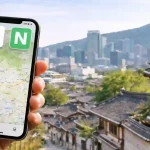
Naver Maps is the standard for navigation in Korea and the one you should have open by default. It covers walking, transit, driving, and cycling directions with real-time data — subway arrival times, bus positions, estimated walking times between connections. The English interface has been significantly improved since 2024 and handles most navigation tasks without Korean language ability.
For transit specifically, Naver Maps shows the full journey: which line, which direction, how many stops, which exit, transfer platform, and estimated arrival. It integrates real-time delay information from Korail and Seoul Metro. If you tap a subway exit on the map, it shows you which street the exit opens onto — useful in Seoul stations where “Exit 3” and “Exit 5” can be 400 metres apart. Download it before you arrive and set it as your default maps app for the duration of the trip.
KakaoMap: The Alternative
KakaoMap is Naver’s main competitor and also uses full Korean mapping data, so it works where Google Maps struggles. Some travellers prefer KakaoMap’s interface; both apps cover the same data. The English interface is slightly less polished than Naver in 2026 but fully functional. If you’re already using Kakao T for taxis, keeping KakaoMap alongside it means one ecosystem for both navigation and ride-hailing.
Why Google Maps Doesn’t Work Well in Korea
South Korean law restricts detailed map data from leaving Korean servers — meaning Google operates with incomplete mapping for Korea. The practical effects: Google Maps often can’t calculate optimal public transit routes, misses real-time bus information, and gives walking directions that don’t account for Korean street-level realities (elevated walkways, underground shopping arcades, subway exits). It’s fine for very rough orientation — getting your bearings in a new neighbourhood — but fails for the precise navigation that Korean transit requires. Use Naver Maps for transit, Google Maps never.
T-Money GO App
The T-Money GO app handles several transport functions that aren’t covered by navigation apps:
- Express bus booking (intercity routes from Seoul Express Bus Terminal)
- Ttareungyi bike-share unlocking if your Climate Card is registered
- T-Money balance checking and top-up
- K-Pass registration and refund tracking for eligible users
It’s not a navigation app — use Naver for that. But for booking intercity buses and managing transit passes, T-Money GO is the one app that does things Naver and Kakao don’t.
Explore more
The GTX-A Launch: A Guide to the New Ultra-High-Speed Suburban Line
K-Pass vs. Climate Card: Which Unlimited Transit Pass Should a Tourist Buy?
Digital T-Money: How to Add a Transport Card to Your iPhone/Android in 2026
KTX-Eum Guide: The Eco-Friendly Way to Reach Gangneung and Andong
Intercity Buses: Using the “T-Money GO” App to Book Express Trips
Jeju Car Rentals: Rules for International Driving Permits (IDP)
AREX Express: Is the 43-Minute Train Still the Best Way to Central Seoul?
KTX Korea: Your Ultimate Guide to High-Speed Train Travel
How to Book KTX Tickets in Korea: A Step-by-Step Guide
KTX Pass vs. Individual Tickets: Which is Cheaper for Your Korea Trip?
📷 Featured image by Jinhan Moon on Unsplash