On this page
- Getting from Busan to Tongyeong
- First Impressions: Arriving at Tongyeong Harbour
- Hallyeo Waterway Cable Car and Mireuksan
- Dongpirang Village: The Mural Hillside
- What to Eat in Tongyeong
- 2026 Budget Reality: What a Day Trip Costs
- Timing Your Visit: Best Season and How to Pace the Day
- Frequently Asked Questions
Getting from Busan to Tongyeong
Most travel content about Tongyeong leaves out the part that actually stresses people out in 2026: the express bus situation has changed. The old Busan Seobu (Sasang) Intercity Bus Terminal still handles Tongyeong routes, but since the Sasang GTX-A connector opened in late 2025, getting there from central Busan is noticeably faster. If you’re staying near Seomyeon or Haeundae, budget about 30–40 minutes to reach Sasang Station before you even board your bus.
By Express Bus (Recommended)
Buses depart from Busan Seobu Terminal to Tongyeong Bus Terminal roughly every 20–30 minutes from around 6:30 AM. The ride takes approximately 1 hour 40 minutes and costs around 12,000–13,500 KRW (~$9–$10 USD) one way. Buy tickets at the terminal counter or through the Kobus app — the app accepts foreign Visa and Mastercard as of 2026. Return buses run until about 9 PM, so you have a comfortable window for a full day.
By Taxi or Ride-Share (Kakao T)
A direct Kakao T Intercity taxi will run you around 80,000–100,000 KRW (~$59–$74 USD) one way. Only worth it if you’re in a group of three or four splitting the cost, or if you missed the last bus. Not a practical solo option.
By Rental Car
The drive via the Namhae Expressway (Route 10) is about 90 kilometres and takes 1 hour 10 minutes without traffic. Parking near Tongyeong Harbour costs 1,000–2,000 KRW per 30 minutes. Driving makes sense if you want to stop at Goseong Dinosaur Museum on the way back, which sits almost exactly between the two cities.
First Impressions: Arriving at Tongyeong Harbour
Tongyeong Bus Terminal is not the prettiest arrival point — it’s a functional transit hub about 1.5 kilometres north of the waterfront. Walk south or grab a local bus (Routes 11 or 12) and within ten minutes you’ll hit the Central Market area, and then the harbour opens up in front of you.
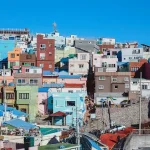
What hits first is the smell — salt air mixed with something faintly smoky, probably from the dried seafood stalls that line the market lanes leading to the water. The harbour itself is quieter and more intimate than Busan’s Jagalchi. Fishing boats in faded blues and reds sit low in the water, and the hills behind the city stack up in terraces of pastel-coloured houses. It genuinely looks more like coastal southern Europe than anything you’d expect in Korea, which is partly why the Naples comparison stuck.

The pedestrian waterfront promenade, Gangguan Hang, is the best place to get your bearings. From here you can see Mireuksan to the southwest (that’s where the cable car goes), and the narrow lanes climbing up to Dongpirang Village on the eastern hill.
Hallyeo Waterway Cable Car and Mireuksan
The Tongyeong Cable Car is legitimately one of the best views in all of South Korea, and in 2026 it still holds up against newer attractions. It runs from a base station on the southwestern edge of the city up to the ridge of Mireuksan (해발 461m), and the gondola ride takes about 9 minutes each way.
At the top, on a clear day, you can see the islands of the Hallyeo Maritime National Park stretching out across the water — dozens of them, scattered and green, with the deep navy blue of the Korea Strait behind them. On a slightly hazy morning, the islands appear in layers, each one a different shade of grey-blue. It’s the kind of view that makes people go quiet.
There’s a walking trail from the upper station to the actual summit (Haneryeo Observatory), about 700 metres each way on a paved path. Allow 30–40 minutes round trip. The observatory platform is small, so if you’re visiting on a weekend in summer, go early or accept that you’ll be squeezing in with tour groups.
- Cable car hours: 9:30 AM – 6:00 PM (last ride up around 5:30 PM; extended to 7:30 PM on weekends in peak season)
- Ticket price: 18,000 KRW round trip (~$13 USD) for adults as of 2026
- Getting there from the harbour: Local Bus Route 11 or a short taxi (~6,000–7,000 KRW)
Dongpirang Village: The Mural Hillside
Tongyeong’s Dongpirang Village predates the now-famous Gamcheon Culture Village in Busan and is, by most measures, more authentic feeling. It started as a community mural project in 2007 when local artists painted the walls of what was at the time a neighbourhood scheduled for demolition. It worked — the project drew enough attention that the demolition was cancelled, and the village has been maintained and refreshed with new murals every few years since.
What makes Dongpirang different from other mural villages in Korea is its size and density. The lanes are genuinely narrow — sometimes barely wide enough for two people to pass — and the murals are painted directly on the walls of houses where people still live. You’ll occasionally hear televisions through open windows and see laundry drying above a painting of a tiger or a field of sunflowers. It doesn’t feel like a theme park.

The entrance path starts near the Central Market, and the full loop through the village takes about 45 minutes to an hour at a relaxed pace. There’s no admission fee. The highest point of the village gives you a clear view down to the harbour and back across to Mireuksan — worth stopping for a few minutes before heading back down.
Avoid visiting on weekend afternoons between July and August. This is when it gets genuinely overcrowded and the narrow lanes become difficult to navigate. Weekday mornings are ideal.
What to Eat in Tongyeong
Tongyeong has one of the strongest regional food identities of any city in Korea its size. The city sits at the intersection of fishing routes and is known for dishes that are not common even in nearby Busan.
Gul (굴) — Tongyeong Oysters
Tongyeong produces around 80% of Korea’s oysters. In winter and early spring (November through March), they’re at peak freshness. You can eat them raw at the Central Market for as little as 10,000 KRW (~$7 USD) for a generous portion, served with vinegar soy sauce and sliced green onion. They’re plump and cold and taste like clean seawater.
Kkungbbang (꿀빵) — Honey Bread
This is Tongyeong’s most famous snack — a round, deep-fried dough ball filled with sweet red bean paste and coated in honey syrup and sesame seeds. Every bakery near the harbour sells them. One piece costs around 1,500–2,000 KRW. They’re best eaten slightly warm.
Daetguk-bap (대구국밥) and Norigae-jorim
Cod soup (daetguk) is a local staple for breakfast or lunch, served with rice and a pile of banchan. A full meal at a local restaurant near the Central Market runs about 10,000–13,000 KRW (~$7–$10 USD). Norigae-jorim — braised small fish with chilli — appears on most tables as a side dish and is worth eating even if you’re not usually a fish person.
Where to Eat
The area around Tongyeong Central Market (통영중앙시장) has the highest concentration of seafood restaurants and stalls. For a sit-down meal, the streets just west of the market entrance have several restaurants with fresh catch displayed outside. Prices are displayed clearly; nothing is designed to confuse tourists.

2026 Budget Reality: What a Day Trip Costs
Here’s what a realistic day costs per person, based on 2026 prices:
- Budget tier (~55,000–70,000 KRW / ~$41–$52 USD): Bus return (27,000 KRW), cable car skipped or substituted with a walk, oysters at the market (10,000 KRW), kkungbbang snack (2,000 KRW), one sit-down meal (12,000 KRW), local bus fares (3,000–4,000 KRW)
- Mid-range (~100,000–130,000 KRW / ~$74–$96 USD): Bus return, cable car round trip (18,000 KRW), proper seafood lunch (25,000–35,000 KRW), coffee, snacks, small souvenir or market purchases
- Comfortable (~180,000–220,000 KRW / ~$133–$163 USD): Rental car or taxi from Busan, cable car, a full seafood spread at one of the harbour restaurants, dessert café, and a bottle of Korean makgeolli to take home
There are no entrance fees for Dongpirang Village or the harbour promenade. The cable car is the only major paid attraction on a typical day itinerary.
Timing Your Visit: Best Season and How to Pace the Day
Tongyeong rewards visitors who plan their arrival time as carefully as their destination. The city faces the Korea Strait, which means sea fog is common in early morning during spring and late autumn — not always bad (the mist on the harbour at 7 AM is actually beautiful), but something to know before you expect sharp visibility from the cable car.
Best Seasons
- Late October to November: Clear skies, cool air, no crowds, oyster season begins. Best overall combination.
- March to April: Cherry blossoms appear in and around the harbour area and on the hillside paths. Popular but manageable on weekdays.
- Winter (December–February): Cold but quiet. Oysters are at their peak. Kkungbbang tastes better warm in cold weather. The cable car experience with clear winter air is excellent.
- July–August: Hot, humid, and crowded with domestic tourists and school groups. Not impossible, but you’ll share every narrow lane in Dongpirang with hundreds of other people.
Suggested Day Pacing
- 7:00 AM — First bus from Sasang Terminal, Busan
- 9:00 AM — Arrive Tongyeong, walk to harbour, quick breakfast (cod soup or market stall)
- 10:00 AM — Cable car (before tour groups arrive)
- 11:30 AM — Return to town, explore Dongpirang Village
- 1:00 PM — Lunch at Central Market area
- 2:30 PM — Waterfront walk, kkungbbang, coffee
- 4:00 PM — Optional: Tongyeong Undersea Tunnel (free, 5-minute walk, historical interest) or Nammang Hill Park
- 6:00–7:00 PM — Head back to bus terminal for evening return to Busan
Frequently Asked Questions
How long does it take to get from Busan to Tongyeong?
By express bus from Busan Seobu (Sasang) Terminal, the journey takes about 1 hour 40 minutes. Buses run every 20–30 minutes from early morning. By car via the Namhae Expressway, it’s around 1 hour 10 minutes depending on traffic. There is no direct train service to Tongyeong.

Is Tongyeong worth visiting as a day trip, or should I stay overnight?
A full day is enough to cover the main highlights — cable car, Dongpirang Village, harbour, and a proper meal. Staying overnight makes sense if you want to take a boat to one of the outer islands, visit in oyster season and eat your way through the market, or explore more remote coastal trails on Mireuksan.
Do I need to book the Tongyeong Cable Car in advance?
No advance booking is required as of 2026. Tickets are sold at the base station on the day. Lines can be long on weekend afternoons in spring and summer, so arriving before 10:30 AM generally avoids a significant wait. Payment by T-Money card or credit card is accepted alongside cash.
What is Tongyeong most famous for?
Tongyeong is best known for its oysters (which supply most of South Korea), its scenic harbour and island views, the Hallyeo Maritime National Park, and Dongpirang mural village. It’s also the birthplace of composer Yun Isang and has a small but genuine arts community rooted in that legacy.
Is Tongyeong easy to navigate without speaking Korean?
Yes, more than most smaller Korean cities. Major attractions have English signage, the bus terminal has English departure boards, and Google Maps navigation works well in 2026 following the updated Korean transit data integration. Most market vendors near the harbour are used to tourists and communicate easily with simple gestures and phone translation apps.
Explore more
Busan Street Food Extravaganza: Your Guide to Must-Try Market Eats
Busan Subway Map & How to Use It: Your Easy Rider’s Guide
Explore Busan’s Best Traditional Markets: A Shopper’s Paradise
📷 Featured image by Falco Negenman on Unsplash.