On this page
- Why Transport Phrases Hit Different in Korea
- Getting On: Buying Tickets, Tapping Cards, and Asking About Fares
- Subway Survival: Lines, Transfers, and Finding the Right Exit
- Bus Korean: Flagging Down, Confirming Stops, and Getting Off
- Asking for Directions on the Street
- Taxis and Ride Apps: Communicating Your Destination
- 2026 Budget Reality: Transport Costs at a Glance
- Frequently Asked Questions
Why Transport Phrases Hit Different in Korea
Google Translate has gotten better, but in 2026 it still fails you at the exact wrong moment — when a bus driver is staring at you, the doors are about to close, and your phone screen has gone dark. Korea’s public transport system is genuinely world-class, but it runs fast. Trains depart on tight schedules, bus drivers don’t wait, and station signage — while increasingly bilingual — still assumes you can read the flow. Knowing even a handful of key Korean phrases means you stay in control instead of guessing. This guide gives you the words you’ll actually use, with Hangul, romanization, and enough context to use them correctly.
Getting On: Buying Tickets, Tapping Cards, and Asking About Fares
The T-Money card and its 2026 successor, the Cashless Korea card (introduced for foreign visitors after the K-ETA system was restructured in late 2025), handle most transit payments automatically. Still, you’ll sometimes need to ask a question at a ticket booth or convenience store counter. These phrases cover those moments.
- 이 카드 어디서 살 수 있어요? — I kadeu eodiseo sal su isseoyo? — “Where can I buy this card?”
- 충전해 주세요. — Chungjeonhae juseyo. — “Please top up [my card].” (Say the amount right after: 오천 원 / ocheon won / 5,000 KRW)
- 얼마예요? — Eolmayeyo? — “How much is it?”
- 서울역까지 얼마예요? — Seoulyeokkkaji eolmayeyo? — “How much to Seoul Station?”
- 1회용 교통카드 주세요. — Ilhoeyong gyotongkadeu juseyo. — “One single-use transit card, please.”
When you tap your card at the subway gate, you’ll hear a short electronic beep — a clean, high-pitched tone that confirms your fare was deducted. If the gate buzzes low and stays closed, your balance is too low. Head to a 충전기 (chungjeon-gi) — the orange or blue top-up machine — before you try again.
Subway Survival: Lines, Transfers, and Finding the Right Exit
Seoul’s subway has over 20 lines in 2026 after the GTX-A express line fully integrated into the city network, connecting Suseo to Unjeong in under 30 minutes. More lines mean more transfers. These phrases help you confirm you’re headed the right way before you commit to a platform.
- 몇 호선이에요? — Myeot hoseonieyo? — “Which line number is it?”
- 환승역이 어디예요? — Hwanseungyeogi eodiyeyo? — “Where is the transfer station?”
- 이 열차 [강남역] 가요? — I yeolcha [Gangnam-yeok] gayo? — “Does this train go to [Gangnam Station]?”
- 몇 번 출구예요? — Myeot beon chulgu yeyo? — “Which exit number is it?”
- 반대 방향이에요. — Bandae banghyangi eyo. — “It’s the opposite direction.” (Useful if someone tells YOU this)
Exit numbers matter enormously in Korea. Telling someone you’re at Hongdae Station is not enough — there are nine exits and they open onto completely different streets. When someone texts you a meetup spot, the exit number is part of the address. Always confirm: 몇 번 출구에서 만날까요? (Myeot beon chulgueso mannalkkayo?) — “Which exit should we meet at?”
Bus Korean: Flagging Down, Confirming Stops, and Getting Off
Korea’s intercity and local buses are cheaper than the subway and reach neighborhoods trains don’t. But they’re less forgiving — drivers move fast, announcements are in Korean only (outside Seoul’s main routes), and the stops can look identical in an unfamiliar area.
- [목적지] 가는 버스가 이거예요? — [Mokjeokji] ganeun beoseuga igeoyeyo? — “Is this the bus going to [destination]?”
- 다음 정류장이 [역 이름]이에요? — Daeum jeongnyujang-i [yeok ireum]ieyo? — “Is the next stop [name]?”
- 내릴 때 알려 주세요. — Naeril ttae allyeo juseyo. — “Please let me know when to get off.” (Say this to a nearby passenger — Koreans are generally happy to help)
- 내려 주세요! — Naeryeo juseyo! — “Please let me off!” (If you need the driver to stop — press the bell button first)
On most Korean buses, there’s a yellow or red bell strip running along the ceiling near the windows. Press it before your stop, not at it. Drivers begin braking immediately after the bell — if you wait until you see your stop, you’ve waited too long.
Asking for Directions on the Street
Koreans are generally willing to help with directions, but the answers often come fast and use landmarks rather than street names. Korea’s address system is block-based, not street-based, so locals navigate by saying things like “turn at the GS25” or “across from the big pharmacy.” Train yourself to listen for a few key direction words.
- [장소]이 어디예요? — [Jangso]-i eodiyeyo? — “Where is [place]?”
- 여기서 얼마나 멀어요? — Yeogiseo eolmana meoreoyo? — “How far is it from here?”
- 걸어서 갈 수 있어요? — Georeoseo gal su isseoyo? — “Can I walk there?”
- 지도에서 보여 주실 수 있어요? — Jidoeseo boyeo jusil su isseoyo? — “Can you show me on the map?”
Key direction words to understand when someone responds:
- 직진 (jikjin) — straight ahead
- 왼쪽 (oenjjok) — left
- 오른쪽 (oreunjjok) — right
- 신호등 (sinhodeung) — traffic light
- 건너편 (geonneopyeon) — across the street / opposite side
- 골목 (golmok) — alley or small side street
If the explanation is going too fast, slow things down with: 천천히 말씀해 주세요. (Cheoncheonhi malsseum hae juseyo.) — “Please speak slowly.”
Taxis and Ride Apps: Communicating Your Destination
Kakao T remains the dominant ride-hailing app in 2026, and it now has a fully functioning English interface — but verbal communication with drivers still comes up, especially in smaller cities where app drivers sometimes call to confirm pickup. Knowing a few taxi phrases keeps things smooth.
- [목적지]로 가 주세요. — [Mokjeokji]-ro ga juseyo. — “Please take me to [destination].”
- 여기서 세워 주세요. — Yeogiseo seweo juseyo. — “Please stop here.”
- 조금 더 앞에서 세워 주세요. — Jogeumdo apeseo seweo juseyo. — “Please stop a little further ahead.”
- 트렁크 좀 열어 주세요. — Teureongkeu jom yeoreo juseyo. — “Could you open the trunk, please?”
- 영수증 주세요. — Yeongsujeung juseyo. — “Receipt, please.”
For addresses, showing the driver your destination on Naver Maps (the most accurate navigation app for Korean roads in 2026) is faster than trying to pronounce an unfamiliar address. Screenshot it before you get in — taxi Wi-Fi is not guaranteed outside Seoul.
2026 Budget Reality: Transport Costs at a Glance
Korea’s public transport is still one of the best values in Asia, though prices did adjust upward in early 2026 following a government fare review.
- Budget tier — Basic subway/bus ride (Seoul): 1,500–1,800 KRW (~$1.10–$1.35 USD). T-Money card required for the lower fare; single-use cards cost slightly more.
- Mid-range — GTX-A express (Suseo to Unjeong): 4,150 KRW (~$3.10 USD) for a single ride. Significant time saving on the northern corridor.
- Mid-range — Intercity bus (Seoul to Busan, express): 28,000–35,000 KRW (~$20–$26 USD) depending on seat class and time of day.
- Comfortable — KTX train (Seoul to Busan): 59,800–78,000 KRW (~$44–$58 USD) standard to first class. Book 2–3 weeks ahead on Korail’s website for the lower end.
- Budget — Taxi (base fare, Seoul): 4,800 KRW (~$3.55 USD) flag fall, then metered. Late-night surcharge (midnight to 4am) adds roughly 20%.
Frequently Asked Questions
Do I really need Korean phrases if I have a translation app?
Translation apps are useful but slow in fast-moving transit situations. A bus driver won’t wait while you type. Knowing five to ten phrases by memory — especially for confirming stops and asking for directions — means you handle real-time situations without fumbling. Apps are a backup, not a replacement for basic spoken Korean.
What is the most useful single Korean phrase for getting around?
어디예요? (Eodiyeyo?) — “Where is it?” — is the backbone of navigation. Pair it with any place name and you have a complete question. It’s short, easy to pronounce, and instantly understood by every Korean speaker you’ll meet on the street or in a station.
Will Koreans understand my pronunciation even if it’s not perfect?
Yes, in most cases. Korean pronunciation has consistent rules, and native speakers are used to hearing foreign accents — especially in Seoul in 2026, where international visitor numbers are at record highs. Speak slowly and clearly rather than rushing. Context helps too: pointing at a map while saying the station name removes most ambiguity.
Is English signage available throughout the Korean transit system?
Seoul’s subway and major intercity stations have strong English signage, and in-train announcements include English on all numbered lines. However, rural bus stops, smaller city bus systems, and some older intercity terminals rely heavily on Korean only. The further you travel from major urban centers, the more useful basic Korean phrases become.
What should I do if I get on the wrong bus or train?
Stay calm and get off at the next stop. For subway: look for a station map on the platform and identify where you are relative to where you’re going. For buses: use Naver Maps offline (download the area in advance) to find the correct route. Say 내려 주세요 (Naeryeo juseyo) to exit, then reorient from there.
Explore more
Your K-Pop Idol Journey: Must-Visit Entertainment Company Buildings in Seoul
Beyond Ramen: Unique Finds at Korean Convenience Stores You Can’t Miss
Shoes Off! Understanding Korean Shoe Etiquette for Visitors
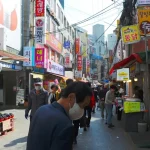
📷 Featured image by Charles Postiaux on Unsplash.