On this page
- The Royal Court Origins of Everyday Korean Food
- How Geography Shaped What Koreans Eat
- The Fermentation Revolution: Why Kimchi Took Over the World
- Japanese Colonial Rule and Its Lasting Mark on the Korean Table
- War, Scarcity, and the Birth of Comfort Food
- 2026 Budget Reality: What Korean Food Actually Costs Today
- Eating with Meaning: The Customs and Rituals Behind the Meal
- Frequently Asked Questions
If you arrived in Korea in 2026 expecting food that matches what you’ve seen on Netflix cooking shows or ordered at a Korean BBQ restaurant back home, you’re in for a pleasant shock. The real story behind dishes like doenjang jjigae, bibimbap, and tteokbokki runs far deeper than social media clips suggest. Many travelers eat their way through Seoul without understanding why the food tastes the way it does, why certain dishes appear at funerals and not at birthdays, or why a bowl of budae jjigae carries genuine historical grief inside it. This article gives you that missing context — and makes every meal you eat in Korea more meaningful.
The Royal Court Origins of Everyday Korean Food
A surprising number of dishes that Koreans eat every day — the kind you find at a Convenience store or a neighborhood pojangmacha — trace their roots directly to the Joseon royal court, which ruled Korea from 1392 to 1897. The court employed full-time royal cooks called sura ganggwan, and meals for the king were elaborate productions involving twelve side dishes, called banchan, arranged in precise positions around the rice bowl.
That tradition of multiple small dishes accompanying the main meal is not just aesthetics. It reflects a deeply held belief in obangsaek — the five cardinal colors (red, green, yellow, white, black) — that must appear in a balanced meal to represent harmony between the body and nature. Court cooks were essentially nutritionists operating under a philosophical system.
Bibimbap is the clearest example. What looks like a simple mixed rice bowl was originally served to the king on the eve of the Lunar New Year to use up leftover food before the new year began — a royal act of frugality dressed up in ceremony. The dish’s colorful arrangement of ingredients is a direct echo of the five-color court philosophy. Today, when you press your spoon into a stone pot bibimbap and hear the rice crackling against the hot dolsot, you are eating something that has traveled five centuries from the Gyeongbok Palace kitchen to your table.
How Geography Shaped What Koreans Eat
Korea is a peninsula roughly the size of Portugal, but its food culture varies dramatically from region to region because of geography, climate, and proximity to the sea. Understanding these regional differences explains why Korean food does not taste the same everywhere and why locals feel strongly protective of their regional dishes.
The southern provinces — particularly Jeolla-do — are Korea’s agricultural heartland, with warm temperatures and fertile plains. Food from this region is famously generous: portions are larger, banchan are more numerous, and seasoning is bolder. Jeolla-do cuisine is often described by Koreans themselves as the standard for “real” Korean food, and the region’s capital, Gwangju, has a local identity tied almost entirely to its table.

The north of the Korean peninsula (including areas now in North Korea) has a colder climate, shorter growing seasons, and historically produced milder, less spicy food. Naengmyeon — cold buckwheat noodles in a chilled broth — originates from Pyongyang, where cold winters made long-storing buckwheat a practical staple. The dish now exists across South Korea but retains its northern identity in name and preparation style.
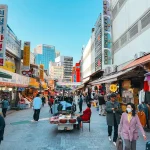
Coastal areas like Busan and the Gyeongnam region built their food culture around raw and fermented seafood. Eo-muk (fish cake), now a ubiquitous street snack eaten on cold days while the steam rises from street vendor vats, was developed in the port city of Busan partly because of cheap access to ground fish. Its salty, savory broth has a smell that hits you the moment you turn onto any winter market street in Korea.
The Fermentation Revolution: Why Kimchi Took Over the World
Before refrigerators, Korean winters were a preservation problem. Fermenting vegetables in salt, chili, garlic, and fish paste was not a culinary choice — it was survival. What became kimchi as we know it today was the result of centuries of iterative problem-solving by ordinary households who needed vegetables to last through freezing months.
Chili peppers, now the defining ingredient of modern kimchi, did not arrive in Korea until the late 16th century, likely brought by Japanese traders following the Imjin War (1592–1598). Before that, kimchi was white, salted, and mild — a form still eaten today called baek kimchi. The incorporation of chili is one of the most significant turning points in Korean food history, producing the red, fiery kimchi that would eventually go global.
By 2026, kimchi has achieved UNESCO Intangible Cultural Heritage status (confirmed in 2013) and is the subject of ongoing scientific research into its probiotic properties. Korean families still observe kimjang — the communal autumn tradition of making large batches of kimchi together — though in cities, kimjang has become partly symbolic, with many apartment residents buying kimchi commercially. Still, the ritual itself is protected cultural practice, and participating in a kimjang event (many temples and cultural centers offer this to visitors in November) gives you a physical understanding of how food creates community in Korea.
Japanese Colonial Rule and Its Lasting Mark on the Korean Table
From 1910 to 1945, Korea was under Japanese colonial control, and the impact on Korean food culture is still visible — though rarely discussed openly. Japan introduced or accelerated several elements of modern Korean eating that Koreans now think of as entirely their own.
Ramyeon (instant noodles) is perhaps the most obvious example. Japan invented instant noodles in 1958, and the technology arrived in Korea during the 1960s through a deeply personal channel: Shin Chunho, a Korean-Japanese businessman, founded the Nongshim company in 1965 specifically to bring affordable noodles to a food-insecure Korean population. Today, Korean ramyeon is its own distinct product — spicier, chewier, and bolder than Japanese ramen — but the origin is Japanese industrial food technology adapted for Korean conditions.
The Japanese colonial period also restructured Korean agriculture to serve Japanese export demands, which reduced dietary diversity and pushed many Koreans into poverty and food scarcity. Dishes that rely on cheap, filling ingredients — rice-heavy meals, fermented pastes, simple broths — became entrenched during this period not purely by choice but by economic necessity. Understanding this makes the simplicity of many traditional Korean meals feel less rustic and more resilient.
War, Scarcity, and the Birth of Comfort Food
The Korean War (1950–1953) destroyed infrastructure, separated families, and created a food crisis that lasted well into the 1960s. Out of that hunger came some of Korea’s most beloved dishes — food that carries real historical memory.
Budae jjigae — literally “army base stew” — was born near the US military bases in Uijeongbu and Songtan when Koreans began collecting surplus American military food: Spam, hot dogs, baked beans, processed cheese. Combined with Korean gochujang paste and vegetables in a single bubbling pot, this fusion was pure desperation cooking. Today it appears on upscale menus and has been through several trendy reinventions, but the dish began as a way for civilians to eat what soldiers were throwing away.
Tteokbokki in its modern form also traces to post-war street food culture. The original royal court version used soy sauce and beef. The red, spicy tteokbokki now sold at every pojangmacha emerged in the 1950s when a vendor in Seoul’s Sindang neighborhood experimented with cheap gochujang and leftover rice cakes. The dish spread because it was filling, cheap, and warming — ideal for a population struggling through cold winters with little money. That version became the default, and now almost no one knows the soy-sauce original.

2026 Budget Reality: What Korean Food Actually Costs Today
Korean food remains remarkably affordable compared to other developed Asian countries, but prices have shifted since 2024. Inflation, rising minimum wages, and post-pandemic reconstruction of the food service industry have all nudged costs upward. Here is an honest breakdown for 2026:
- Budget tier: Convenience store meals (kimbap, triangle rice balls, cup ramyeon) — 1,500–4,000 KRW (~$1.10–$3.00 USD). A full dosirak (convenience store lunch box) runs about 5,000–7,000 KRW (~$3.70–$5.20 USD). These have improved significantly in quality since 2024 — CU and GS25 now offer hot food counters in most Seoul locations.
- Mid-range tier: A bowl of gomtang (beef bone soup), bibimbap, or sundubu jjigae at a sit-down restaurant — 9,000–14,000 KRW (~$6.70–$10.40 USD). Korean set meals at local restaurants typically include soup, rice, and 4–6 banchan at no extra charge. This tier offers the best value.
- Comfortable tier: Traditional Korean table d’hôte meals (hanjeongsik) — 30,000–80,000 KRW (~$22–$59 USD) per person. These multi-course experiences are worth doing at least once, especially in Jeonju or traditional hanok dining spaces in Seoul’s Bukchon area. They represent the closest thing available to experiencing royal court-style eating.
- Street food: Tteokbokki, hotteok, eomuk, corn dogs — 2,000–5,000 KRW (~$1.50–$3.70 USD) per item. Prices at Gwangjang Market and Myeongdong have increased since 2024 due to tourist demand, but neighborhood street stalls remain cheap.
One practical 2026 note: many local restaurants now accept payment via KakaoPay and Naver Pay QR codes displayed at the counter. Cash is still widely accepted and sometimes preferred at traditional establishments. Physical T-Money cards, while primarily a transit tool, can also be used at some convenience store checkouts — the familiar beep of the card reader is one of the most ubiquitous sounds of daily Korean life.
Eating with Meaning: The Customs and Rituals Behind the Meal
Korean food is not just about flavor — it is embedded in a social system with rules that reflect Confucian values around age, hierarchy, and collective care. Getting these right (or at least understanding them) transforms a meal from a simple transaction into a genuine cultural experience.

The most important rule at a Korean table is not eating before elders begin. If you are seated with older Koreans, you wait until the most senior person lifts their spoon. This is not rigid ceremony — it is genuine respect that Koreans practice automatically. Foreigners who observe this without being prompted earn immediate, visible appreciation.
Pouring drinks for others but never for yourself is a related custom. At any shared meal involving alcohol — soju, makgeolli, or beer — you refill your neighbor’s glass and they refill yours. Pouring your own drink signals that no one is taking care of you, which in a Korean social context is an awkward message to send.
Certain foods carry specific ritual weight. Seaweed soup (miyeok guk) is eaten on birthdays — it is the food mothers eat after childbirth, so children eat it annually to honor that sacrifice. Eating it on an exam day is considered bad luck (it is too slippery — symbolically, you might “slip” on the test). White rice cake (baek tteok) appears at births and certain ceremonial occasions because its pure white color represents fresh beginnings. Red bean rice cake (patjeon) is specifically avoided at these same events because red is associated with death and misfortune in Korean traditional belief. These are not superstitions that Koreans necessarily believe literally — but they are observed, because honoring the custom honors the people around you.
Frequently Asked Questions
Why is Korean food so spicy compared to other Asian cuisines?
Chili peppers arrived in Korea in the late 1500s and were rapidly adopted because they preserved food effectively and were cheap to grow. Over centuries, the Korean palate adjusted and actually began to prefer higher heat levels. Today, capsaicin tolerance is genuinely higher among regular Korean diners than in many neighboring cultures.
What is the difference between Korean food in Seoul versus in Jeonju?
Jeonju, in the Jeolla-do region, is widely regarded as Korea’s food capital. Meals there tend to include more banchan, richer seasoning, and stronger fermented flavors. Seoul’s food culture is faster-paced and more influenced by global trends. The base ingredients and techniques are the same, but Jeonju’s version is generally considered more traditionally elaborate.
Is Korean food safe for vegetarians and vegans?
This is genuinely complicated in 2026. Many dishes that appear vegetarian contain fish paste, dried shrimp, or anchovy stock. Buddhist temple food (sachal eumsik) is the most reliable fully plant-based option and is widely available. Some restaurants now label vegan options explicitly, particularly in Seoul’s Itaewon and Mapo districts.

What does it mean when a Korean meal includes many small dishes?
The banchan system reflects both royal court tradition and the Confucian value of providing abundance to guests. Each dish is shared communally — you do not finish your own portion of banchan, you take small amounts repeatedly throughout the meal. The number of dishes also traditionally reflected the social status of the household serving you.
Why do Koreans eat rice and soup together rather than in sequence?
In Korean eating culture, rice, soup, and banchan are consumed simultaneously and in rotation — not in courses. The soup moistens each bite of rice, aids digestion, and adds warmth. This style comes from a long agricultural tradition where one bowl of rice needed to stretch across an entire meal, with liquid helping each mouthful go further.
Explore more
Beyond Annyeonghaseyo: 20 Must-Know Korean Phrases for Travelers
Beyond the Screen: How to Visit Goblin Filming Locations in Korea
How to Eat a Full Meal at a Korean Convenience Store (On a Budget!)
📷 Featured image by Jesse Plum on Unsplash.