On this page
- What Makes Korean Cuisine More Than Its Famous Staples
- Fermented and Funky: The World Beyond Kimchi
- Regional Food Identities: Why Location Shapes the Plate
- The Forgotten Grains and Porridges
- Offal, Intestines, and Acquired Tastes
- Temple Food: Korea’s Ancient Plant-Based Tradition
- 2026 Budget Reality: What Korean Food Actually Costs
- Frequently Asked Questions
Most first-time visitors to South Korea arrive with a mental checklist: bibimbap, Korean BBQ, tteokbokki, and yes — kimchi. These are real, genuinely wonderful dishes. But sticking to that list in 2026 is a bit like visiting Italy and only Eating spaghetti bolognese. Korean food culture runs extraordinarily deep, and a growing number of travelers are starting to realize it. The challenge is knowing where the depth actually lies.
What Makes Korean Cuisine More Than Its Famous Staples
Korean food is built on a philosophical framework called obangsaek (오방색) — five cardinal colors representing balance across nature: red, yellow, green, white, and black. This isn’t decoration. It’s a guiding principle. A well-composed Korean meal attempts to balance these colors on the table, which explains why a single meal might include five completely different side dishes — banchan (반찬) — each one rooted in seasonal produce, preservation technique, or regional tradition.
The concept of yakshik dongwon (약식동원) also runs through Korean food culture. The phrase roughly translates to “food and medicine share the same origin.” Koreans have historically treated eating as a health practice, not just a pleasure. Ingredients like ginger, garlic, perilla, and doenjang (fermented soybean paste) appear constantly — not for flavor alone, but because generations believed they sustained the body. This explains why Korean cuisine resists simplification. Every dish carries context.
Fermented and Funky: The World Beyond Kimchi
Kimchi gets all the attention, but it is just one item in a vast fermentation tradition that Koreans call jang (장) culture. The real pillars of Korean cooking are the fermented pastes and sauces that form the base of almost everything else.
- Doenjang (된장) — A dense, pungent soybean paste that functions like Korean miso but with a rougher, more complex character. Doenjang jjigae (soybean paste stew) is eaten for breakfast, lunch, and dinner across the country.
- Ganjang (간장) — Korean soy sauce, but specifically joseon ganjang (조선간장), the traditionally brewed version, has a thinner, saltier, more mineral quality than Japanese soy sauce. It’s used in seasoned namul vegetable dishes and soups.
- Gochujang (고추장) — The fermented red chili paste most outsiders know from bibimbap, but few realize it’s aged in large clay jars called onggi (옹기) for months, sometimes years, which builds layers of sweetness beneath the heat.
- Jeotgal (젓갈) — Salted, fermented seafood. Tiny shrimp, squid, pollack roe — all preserved in salt and used as condiments or fermented into kimchi. The smell hits hard. The taste is deeply savory.
These ferments are not condiments in the Western sense. They are the backbone. Understanding them changes how you read every Korean menu.
Regional Food Identities: Why Location Shapes the Plate
Korea is roughly the size of the state of Indiana, yet its regional food differences are striking. Geography, climate, and historical politics all left marks on local cooking styles.
Jeonju (전주), in North Jeolla Province, is considered the spiritual home of Korean cuisine. The city has earned a UNESCO Creative City of Gastronomy designation, and locals take that seriously. Jeonju bibimbap uses locally grown short-grain rice, a specific variety of bean sprout, and raw egg yolk — and it is served in a stone bowl only when you explicitly request it hot. The room-temperature version, which most visitors don’t know exists, has a completely different texture.
Busan, on the southeastern coast, runs on seafood. The city’s defining dish is milmyeon (밀면) — wheat noodles in cold broth, developed by northern Korean refugees in the 1950s who couldn’t find buckwheat to make their traditional naengmyeon. It’s one of the most historically loaded bowls of noodles in the country.
Andong (안동), in North Gyeongsang Province, represents the conservative Confucian food tradition. Andong jjimdak (안동찜닭) — braised chicken with glass noodles and soy-based sauce — and Andong soju, a traditionally distilled rice spirit at around 45% alcohol, both originate here. This is not the sweet, mild soju you find everywhere else.
Jeju Island has its own food ecosystem shaped by volcanic soil, ocean exposure, and a historically isolated culture. Heukdwaeji (흑돼지), the black-haired native pig breed, has darker, fattier meat than mainland pork and is grilled differently — thicker cuts, longer on the flame.
The Forgotten Grains and Porridges
White rice dominates the modern Korean table, but it wasn’t always the primary grain. Barley, millet, sorghum, and mixed grains called japgok (잡곡) were staples for most of Korean history. Today, health-conscious Koreans — and many older generations outside of cities — still cook japgokbap (잡곡밥), rice mixed with several grains, which has a nutty, slightly chewy texture and a more complex flavor profile than plain white rice.
Juk (죽) — Korean rice porridge — is one of the most underappreciated comfort foods in the cuisine. Unlike Chinese congee, Korean juk tends to be thicker and richer, cooked low and slow until the grains dissolve into a smooth, creamy consistency. Abalone juk (jeonbokjuk) is the prestige version, but pumpkin juk (hobakjuk) and pine nut juk (jatjuk) show how delicate the dish can be. It’s served to the sick, the elderly, and to anyone recovering from a difficult night.

Nurungji (누룽지) is the crispy layer of rice that forms at the bottom of a stone pot. Koreans pour hot water over it to create a light, smoky tea-like broth — called sungnyung (숭늉) — traditionally served at the end of a meal. In a country where every grain is respected, even the burnt part has a purpose.
Offal, Intestines, and Acquired Tastes
Korean food does not shy away from the whole animal. The nose-to-tail tradition runs deep, shaped by centuries of agricultural economy where wasting any part of a slaughtered pig or cow simply wasn’t an option.
Gopchang (곱창) — small intestines, usually pork or beef — are grilled over charcoal until the outside crisps and the inside remains rich and almost custard-like in texture. The smell while cooking is strong and barnyard-adjacent. The taste, once you’re past that, is deeply savory.
Sundae (순대) is Korean blood sausage — pig intestine stuffed with glass noodles, barley, and pork blood, then steamed. It bears almost no resemblance to European blood sausage. The texture is soft and slightly sticky. It’s sold as street food, eaten with salt and perilla powder, and is one of the most democratic snacks in the country — cheap, filling, and deeply local.
Bosintang remains a sensitive topic. Dog meat soup has declined dramatically in consumption and was formally prohibited under new legislation passed in 2024. In 2026, it is effectively no longer part of mainstream food culture, though the conversation around it persists in discussions of culinary tradition and animal welfare.
Temple Food: Korea’s Ancient Plant-Based Tradition
Long before plant-based eating became a global trend, Korean Buddhist monks had spent over a thousand years perfecting a cuisine built entirely around vegetables, grains, and fermented foods — with one additional constraint. Sachal eumsik (사찰음식), temple food, excludes not just meat and fish but also the five pungent vegetables: garlic, green onions, wild chives, leeks, and Asian chives. Buddhist philosophy holds that these vegetables stimulate anger and desire, disturbing the mind.
The result is a cuisine of remarkable restraint and ingenuity. Without these aromatics, temple cooks rely on fermentation, slow cooking, and careful seasoning to build flavor. A dish of simple braised lotus root in soy and sesame becomes a meditation on texture. Fermented wild greens, dried mushrooms reconstituted in spring water, and handmade tofu served with nothing but perilla oil — the minimalism is intentional and striking.

In 2026, UNESCO recognition of Korean temple food (inscribed in 2024 as part of the broader Korean temple stay program expansion) has increased international interest significantly. Some temple stays now include formal cooking workshops conducted in English, run through the Jogye Order of Korean Buddhism’s official cultural programs.
2026 Budget Reality: What Korean Food Actually Costs
One of Korea’s genuine advantages as a food destination is price. Even in 2026, after several years of inflation, eating well here remains accessible at almost every budget level.
Budget Tier (under 10,000 KRW / ~$7.40 USD per meal)
- Gimbap roll from a gimbap restaurant: 3,000–4,500 KRW (~$2.20–$3.30)
- Sundae street snack portion: 3,000–5,000 KRW (~$2.20–$3.70)
- Instant ramyeon with egg at a convenience store sit-down: 2,500–4,000 KRW (~$1.85–$3.00)
- Juk (basic rice porridge, takeaway): 6,000–9,000 KRW (~$4.40–$6.70)
Mid-Range Tier (10,000–25,000 KRW / ~$7.40–$18.50 USD per meal)
- Doenjang jjigae set with rice and banchan: 10,000–14,000 KRW (~$7.40–$10.40)
- Gopchang (grilled intestines, per person with sides): 15,000–22,000 KRW (~$11.10–$16.30)
- Jeonju bibimbap at a traditional restaurant: 12,000–18,000 KRW (~$8.90–$13.30)
- Milmyeon in Busan: 9,000–13,000 KRW (~$6.70–$9.60)
Comfortable Tier (25,000–80,000 KRW / ~$18.50–$59.30 USD per meal)
- Temple food tasting menu at a city-based sachal eumsik restaurant: 35,000–55,000 KRW (~$25.90–$40.70)
- Andong jjimdak full pot for two: 28,000–38,000 KRW (~$20.70–$28.10)
- Jeonbokjuk (abalone porridge) at a quality establishment: 25,000–40,000 KRW (~$18.50–$29.60)
- Heukdwaeji grilled pork per person on Jeju: 30,000–50,000 KRW (~$22.20–$37.00)
Tap water in Korea is safe to drink and free in all restaurants. Most traditional Korean restaurants still include banchan side dishes at no extra charge — this has not changed despite the general price increases of the mid-2020s, though the number of side dishes has reduced at some establishments.
Frequently Asked Questions
Is Korean food always spicy?
No — this is one of the most persistent misconceptions about the cuisine. Many foundational Korean dishes are mild or have no chili at all: doenjang jjigae, juk, ganjang-based namul vegetables, and most temple food contain no gochugaru. Spice intensity varies significantly by region and dish type, and cooks generally adjust heat on request.
What is banchan and do you pay extra for it?
Banchan are the small side dishes served alongside the main course in traditional Korean meals — kimchi, seasoned vegetables, braised tofu, and similar items. At the vast majority of Korean restaurants, banchan is included in the meal price with no added charge, and you can typically ask for refills of most items at no extra cost.

How different is temple food from regular Korean vegetarian food?
Significantly different. Temple food excludes five pungent vegetables — garlic, green onions, chives, leeks, and Asian chives — that are staples of regular Korean cooking. This creates an entirely distinct flavor profile. Regular Korean vegetarian food (which is less common as a category) typically still uses these aromatics freely. Temple food is a separate culinary tradition with its own techniques and philosophy.
What Korean fermented foods are safe to try for people with sensitive stomachs?
Start with doenjang jjigae (soybean paste stew), which is cooked and therefore gentler than raw ferments. Ganjang (Korean soy sauce) is also easy to tolerate. Jeotgal (salted fermented seafood) and heavily fermented kimchi can cause discomfort in people unaccustomed to strong fermented foods — try small amounts first and build gradually.
Has Korean food changed much since 2024?
The fundamentals haven’t changed, but a few things have shifted. The formal prohibition of dog meat consumption in 2024 removed one long-contested element. Temple food gained wider international visibility after UNESCO recognition. Prices across the board increased roughly 12–18% between 2024 and 2026, though Korean food remains significantly cheaper than equivalent quality dining in most Western countries.
Explore more
Survival Korean Phrases for Tourists: Your Ultimate Seoul Survival Guide
Ultimate K-Drama Filming Locations Guide for Your Seoul Trip
Your Ultimate Guide to Korean Convenience Store Culture
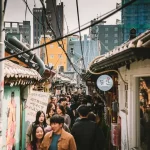
📷 Featured image by Seungwon Lee on Unsplash.