On this page
- Hierarchy, Indirect Communication, and Why Your Directness Will Land Wrong
- The Banking and Payments Wall (and How to Get Over It)
- Health Insurance — What the Law Actually Requires of You in 2026
- Housing Reality: Goshiwon, Officetels, and the Deposit System That Confuses Everyone
- 2026 Budget Reality — What It Actually Costs to Live and Work Here
- The Social Integration Problem Nobody Warns You About
- Frequently Asked Questions
South Korea in 2026 is not the frictionless Digital nomad paradise that some YouTube channels sell. Internet is fast, food is cheap, and transport works. But the country also has a bureaucratic layer, a distinct social code, and a residency infrastructure that was not built with location-independent workers in mind. Most people who struggle here do not struggle because of the language barrier. They struggle because they walked in expecting a long holiday and discovered they were actually trying to function inside a tightly structured society. If you are planning one to six months of working remotely from Korea, this article covers what that actually looks like.
Hierarchy, Indirect Communication, and Why Your Directness Will Land Wrong
Korean social life runs on a system called nunchi — roughly, the ability to read a room and respond to what is not being said. Foreigners who skip this and communicate bluntly are not seen as refreshingly honest. They are seen as lacking awareness. This matters more than you might expect when you are trying to build a local network, negotiate a lease, or sort out a problem with a landlord.
Age determines almost everything about how a conversation flows. Koreans you meet will often ask your age within the first two minutes — not to be rude, but to calibrate the register they should use with you. If you are older, they will defer to you. If you are younger, expect to be treated more familiarly, which can feel warm but sometimes tips into paternalism.
In practical terms, this means a few things. When someone says gwaenchanayo (it’s fine, no problem), it does not always mean the problem is resolved. It often means the conversation has become uncomfortable. If a co-working receptionist tells you “I’ll check on that,” the answer may never come — not because they forgot, but because the actual answer was no, and saying no directly felt impolite. Learning to follow up gently, without applying the kind of pressure that reads as aggressive, is a skill worth developing fast.
Respect for elders also plays out in everyday settings. On the subway, younger people routinely give up seats for older passengers without being asked. In shared housing, making noise late at night is taken far more seriously than in many Western countries. The implicit social contract here is strong, and people will tolerate a lot in silence before expressing frustration — and then express it all at once.
The Banking and Payments Wall (and How to Get Over It)
Opening a Korean bank account as a foreigner on a short-stay visa is one of the more frustrating administrative tasks you will face. As of 2026, the K-ETA electronic travel authorisation allows visa-free entry for most Western passport holders, but it does not give you the residency status banks want to see. Without an Alien Registration Card (ARC), most major banks — Kookmin, Shinhan, Hana — will offer you a restricted non-resident account that limits transfer amounts and does not connect to some payment systems.
The practical workaround most nomads use in 2026: open a KakaoBank or Toss Bank account using a foreigner registration number once your ARC is issued, or use an international card like Wise or Revolut for day-to-day spending in the meantime. Both Wise and Revolut cards work at Korean ATMs and tap-to-pay terminals without issue. The small thud of a Wise card against a subway reader feels identical to the tap of a local T-Money card, and for the first month, that is good enough.
The bigger friction is that many Korean online services — streaming, food delivery, certain government portals — require a Korean phone number and sometimes a Korean national ID for verification. You can solve the phone number issue immediately by picking up a prepaid SIM at Incheon Airport (KT, SKT, and LG U+ all have desks before you exit arrivals). For services requiring a Korean ID, you will need to either wait until your ARC is issued or use a platform that accepts foreign passport verification — the list of these has grown in 2026, particularly for tax filing and health insurance registration.
Health Insurance — What the Law Actually Requires of You in 2026
This is the section most digital nomad guides skip, and it is the one that can create real financial and legal problems. Korea’s National Health Insurance Service (NHIS) updated its mandatory enrollment rules in 2024, and those rules are now firmly enforced. If you stay in Korea for more than six months and hold an ARC, you are legally required to enroll in the NHIS. There is no opt-out for foreigners who “have their own insurance.”
The minimum monthly premium for a foreigner enrolled as a local subscriber (지역가입자) in 2026 is approximately 140,000 KRW (~$104 USD) per month. This is based on a minimum income floor — if you declare higher income, your premium rises proportionally. The NHIS covers roughly 60–80% of most medical costs, and Korea’s hospitals are genuinely excellent, so this is not money wasted. However, if you arrive on a workation visa (F-1-D or a long-stay tourist visa extension) and remain under the six-month threshold, private travel insurance is sufficient — but it must have a minimum coverage of 100 million KRW (~$74,000 USD) to satisfy visa extension requirements.
The F-1-D workation visa, introduced in late 2023 and refined in 2025, requires proof of remote income with a monthly floor of $2,000 USD equivalent in foreign-sourced earnings. You will need three months of bank statements, an employment contract or client contracts, and proof that your employer or clients are based outside Korea. Tax obligations remain with your home country under this visa — Korea does not tax foreign-sourced remote income for F-1-D holders staying under 183 days in a calendar year.
Housing Reality: Goshiwon, Officetels, and the Deposit System That Confuses Everyone
Korea has two housing cost systems that exist almost nowhere else. Understanding them before you sign anything saves real money.
Goshiwon are small single rooms — typically 5 to 8 square metres — in purpose-built buildings with shared or semi-private bathrooms. They are used by students and budget workers, and they are entirely functional for someone who spends most of their day out or at a desk. Monthly rent in Seoul in 2026 runs between 350,000 and 600,000 KRW ($260–$445 USD) including utilities. Noise is the main complaint. Walls are thin, and the hum of other residents at 11pm can make late-night calls difficult.
Officetels are studio apartments designed for both living and light commercial use — they are legal to inhabit and often have a built-in desk setup, which suits remote workers well. Monthly rent in a mid-city Seoul officetel in 2026 runs from 700,000 to 1,400,000 KRW ($520–$1,040 USD) depending on size and location.
The deposit system — called jeonse in its full form and wolse in its partial form — is where confusion starts. Most short-term rentals use a hybrid: a smaller lump-sum deposit (보증금, bojeunggeum) of anywhere from 1,000,000 to 10,000,000 KRW ($740–$7,400 USD) held against the lease, plus monthly rent. The deposit is returned when you leave, assuming no damage. Foreigners on short stays almost never access full jeonse (which involves deposits equivalent to 60–80% of a property’s value in exchange for zero monthly rent). For 1–6 month stays, monthly furnished rentals through platforms like Zigbang or Airbnb long-stay are the realistic path.
2026 Budget Reality — What It Actually Costs to Live and Work Here
These are honest monthly figures for Seoul in 2026, excluding flights.
- Budget tier (goshiwon + cooking at home + public transport): 1,100,000–1,500,000 KRW/month ($815–$1,110 USD). This is viable but requires comfort with small spaces and shared facilities.
- Mid-range tier (officetel + mix of cooking and eating out + transport + occasional leisure): 2,200,000–3,000,000 KRW/month ($1,630–$2,220 USD). This is the range most working nomads land in after the first month of adjustments.
- Comfortable tier (larger officetel or furnished apartment, regular restaurant meals, gym, day trips): 3,500,000–5,000,000 KRW/month ($2,590–$3,700 USD).
Food costs are genuinely low if you eat Korean. A dosirak (bento-style lunch box) from a convenience store runs 4,000–6,000 KRW ($3–$4.50). A sit-down gukbap (rice and soup) at a local restaurant is 8,000–10,000 KRW ($6–$7.50). The smell of fermented soybean paste bubbling in an earthenware pot at a local sikdang is part of the daily rhythm here — lunch crowds pack these places between 12pm and 1:30pm, and they clear out fast. Western food and specialty coffee drive costs up significantly.
Health insurance (if required), co-working day passes, and a data SIM are additional fixed costs. A monthly unlimited data SIM from KT or SKT runs approximately 33,000–55,000 KRW ($24–$41 USD) in 2026.
The Social Integration Problem Nobody Warns You About
Korea has one of the most active going-out cultures in Asia, and paradoxically, it can be one of the loneliest countries for foreign arrivals. Korean social groups tend to be closed and long-established — people often socialise with the same friends they have had since university, and there is not a strong culture of integrating new acquaintances into existing circles quickly.
This does not mean Koreans are unfriendly — they are often generous to strangers in practical ways. Someone will help you figure out a vending machine, share an umbrella, or point you in the right direction at a train station without hesitation. But converting that transactional warmth into a genuine friendship takes longer than it does in many other countries.
The structures that work are organised ones. Language exchange meetups (the 2026 iteration of apps like Tandem and HelloTalk now has in-person event functions), hiking clubs, and volunteer teaching programs all create repeated contact — which is how Korean friendships actually form. One genuine connection made through a regular weekly commitment is worth ten networking events. Showing up consistently, being humble about your Korean (even two or three phrases of effort get noticed), and accepting that things move slowly will get you further than trying to apply social frameworks from back home.
If you are here for six months and genuinely want to feel less like a visitor, learning to read hangul — the Korean alphabet — takes about a week of focused effort and unlocks menus, signage, transport maps, and a layer of respect from the people around you. It does not require speaking Korean fluently. It just signals that you are paying attention.
Frequently Asked Questions
Do I need a special visa to work remotely from South Korea in 2026?
Visa-free stays under 90 days are available to most Western passport holders via K-ETA. For longer stays, the F-1-D workation visa allows up to one year and requires proof of foreign-sourced income of at least $2,000 USD per month. Working for Korean clients or employers on this visa is not permitted.
Is Korea actually affordable for digital nomads compared to Southeast Asia?
Seoul is more expensive than Chiang Mai or Bali but cheaper than Tokyo or Singapore. Mid-range monthly costs run $1,600–$2,200 USD. Smaller Korean cities like Jeonju or Chuncheon can reduce costs by 20–30% while still offering full infrastructure. Food costs remain a genuine advantage at every tier.
Can I open a Korean bank account without an Alien Registration Card?
Most full-service accounts require an ARC, which you can apply for after 90 days in country on certain visas. Before then, international cards like Wise or Revolut function well for daily spending. KakaoBank and Toss Bank are more foreigner-accessible once your ARC is issued than traditional branch banks.
How does the mandatory health insurance rule affect short-stay nomads?
Stays under six months on a tourist or K-ETA entry do not trigger mandatory NHIS enrollment. Stays over six months with an ARC do. Private travel insurance covering a minimum of 100 million KRW ($74,000 USD) is sufficient for shorter periods. Check your visa category carefully — the rules differ by visa type.
How hard is the language barrier for day-to-day life?
English signage in Seoul is extensive, and Naver Map and Kakao Map both offer English interfaces in 2026. Outside major cities, English availability drops. Learning to read Hangul — not speak Korean, just read the script — resolves most practical friction quickly and takes roughly one focused week of study.
Explore more
Extending Your Stay: Long-Term Visa Options for Digital Nomads in Korea
Co-working vs. Cafes: Where to Work Remotely in Korea
Balancing Work and Wanderlust: A Digital Nomad’s Guide to Korea Workations
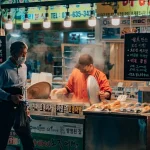
📷 Featured image by Ethan Brooke on Unsplash.