On this page
- Why Suwon Works as a Day Trip in 2026
- Hwaseong Fortress — Walking the Wall Without the Crowds
- The Views You Actually Come For — Seobukgongsimdon & Paldalmun
- Eating Your Way Through Suwon — The Galbi Capital of Korea
- Paldalmun Market & Rodeo Street — Beyond the Obvious Tourist Loop
- Getting to Suwon from Seoul (and Busan)
- Getting Around Suwon Once You’re There
- 2026 Budget Reality — What a Day in Suwon Actually Costs
- Day Trip or Overnight?
- Frequently Asked Questions
💰 Click here to see Korea Budget Breakdown
💰 Prices updated: 2026-10-01. Budget figures are estimates — always verify before travel.
Exchange Rate: $1 USD = 1,356 KRW
Daily Budget (per person) • Pricing updated as of 2026-10-01
Daily Budget
Shoestring: 60,000 KRW - 95,000 KRW ($44.25 – $70.06)
Mid-range: 130,000 KRW - 250,000 KRW ($95.87 – $184.37)
Comfortable: 350,000 KRW - 550,000 KRW ($258.11 – $405.60)
Accommodation (per night)
Hostel/guesthouse: 25,000 KRW - 65,000 KRW ($18.44 – $47.94)
Mid-range hotel: 90,000 KRW - 165,000 KRW ($66.37 – $121.68)
Food (per meal)
Budget meal (street food): 9,000 KRW ($6.64)
Mid-range meal (restaurant): 22,000 KRW ($16.22)
Upscale meal: 65,000 KRW ($47.94)
Transport
Single subway/bus trip: 1,600 KRW ($1.18)
Climate Card (30-day unlimited): 67,000 KRW ($49.41)
Seoul day trips in 2026 have a crowding problem. Nami Island is packed by 10am, the DMZ tours book out weeks ahead, and Bukchon feels more like a queue than a neighborhood. Suwon, sitting just 30 kilometers south of Seoul, somehow still flies under the radar — which is remarkable given that it holds one of Korea‘s greatest UNESCO World Heritage sites and arguably the country’s best barbecue. If you have one day to spare, this city rewards you more than most.
Why Suwon Works as a Day Trip in 2026
Suwon is the capital of Gyeonggi Province and home to about 1.3 million people, which means it functions like a real city rather than a preserved museum town. That matters. You eat where locals eat, you walk streets that are actually used, and you don’t feel like you’ve stepped into a theme park version of Korean history.
The core attraction — Hwaseong Fortress — is compact enough to walk in three to four hours, but the surrounding neighborhoods have enough food, markets, and street life to fill a full day comfortably. The 2026 tourist infrastructure has also improved noticeably. The Suwon Tourist Information Center near Paldalmun was upgraded in late 2025 and now offers English-language walking maps, a luggage storage service, and a small café. It’s a useful first stop.
One more thing: Suwon is genuinely easy to reach from Seoul, and the trip is cheap. That combination — accessibility, affordability, and a UNESCO fortress — should make it one of Korea’s most-visited day trips. The fact that it isn’t is your advantage.
Hwaseong Fortress — Walking the Wall Without the Crowds
Built between 1794 and 1796 under King Jeongjo of the Joseon Dynasty, Hwaseong Fortress stretches 5.7 kilometers around the hillside and lower town of Suwon. The whole circuit takes about two and a half to three hours on foot at a relaxed pace. You can shorten it, but the full loop is worth it — the fortress changes character completely as you move from the commercial lower section near Paldalmun to the pine-forested ridge sections in the north and west.
The northern stretch near Janganmun Gate and the western ridge walk up to Seobukgongsimdon are the quietest and most dramatic sections. On a clear morning, the pine smell off the hillside is sharp and clean, and the only sounds are wind and the occasional crow. By contrast, the southern stretch near Paldalmun is busy with locals commuting through the gate on foot and by bike — a reminder that this fortress is still a living part of the city, not a roped-off relic.
Entry to the fortress walls is 1,000 KRW (under $1 USD) for adults. Children under 7 are free. The gates themselves — Paldalmun, Janganmun, Hwaseomun, and Changnyongmun — are all free to walk through at ground level. The paid ticket gets you access to the wall walk itself, purchased at any of the gate ticket booths.
The Views You Actually Come For — Seobukgongsimdon & Paldalmun
Two spots on the fortress circuit are genuinely worth stopping for longer than the average Instagram pause.
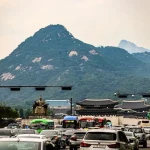
Seobukgongsimdon is the northwest bastion — a circular watchtower that sits at the highest accessible point of the western wall. From here, on a clear day, you can see across the entire Suwon basin, past the old town rooftops, to the Gwanggyo mountains in the distance. It’s the kind of panorama that makes you understand why the Joseon court chose this site. The tower itself is two stories, and the upper level is open-air. Early morning light hits the tile roofs of the palace area below in a way that genuinely rewards getting here before 10am.
Paldalmun, at the southern end of the fortress, is a different experience — more urban, more alive. It’s one of only two remaining Joseon-era city gates in Korea that still stands in the middle of active traffic (Namdaemun in Seoul is the other). Watching the evening light fall across the gate arch while motorbikes and taxis weave around it is a strangely satisfying collision of old and current Korea.
Eating Your Way Through Suwon — The Galbi Capital of Korea
Suwon has a legitimate claim to being the galbi (grilled short rib) capital of Korea. The style here is specific: thick-cut beef ribs, marinated overnight, grilled tableside over charcoal. The cut is longer and meatier than the thin-sliced version common in Seoul. The fat renders slowly and the caramelized edges have a sweetness that’s distinct from other regional styles.
The main galbi strip is Suwon Wanggalbi Street (수원왕갈비거리), a short walk east of Paldalmun. This strip has been famous since the 1940s, and several restaurants here have been operating for over 50 years. Yongseong Sikdang and Hwachun Sikdang are two long-standing options. Expect to pay 35,000–55,000 KRW ($26–$41 USD) per portion for two to three ribs — it’s not a budget meal, but it is an experience specific to this city.

For something cheaper, the stalls inside Paldalmun Market sell sundae (blood sausage with glass noodles), hotteok (sweet pancakes with brown sugar filling), and tteokbokki. A full street food lunch here comes to 8,000–12,000 KRW ($6–$9 USD).
Paldalmun Market & Rodeo Street — Beyond the Obvious Tourist Loop
Most day-trippers walk the fortress wall, eat galbi, and leave. That misses two of Suwon’s more interesting ground-level experiences.
Paldalmun Traditional Market, directly adjacent to the south gate, is a proper working market — not a curated food hall. The covered alleys sell dried fish, seasonal vegetables, handmade tofu, and live seafood alongside cheap restaurants and pojangmacha (street food tents). It’s crowded in the early afternoon, noisy, and smells of sesame oil and frying batter. That’s the point. Wander without a plan and you’ll eat better than at any sit-down tourist restaurant nearby.
Rodeo Street (로데오거리) runs north from the market area toward Suwon Station and is where younger Suwon residents shop and eat. It’s lined with independent clothing stores, Korean fried chicken shops, and small cafés. The vibe is relaxed and unpretentious. It won’t replace Hongdae or Seongsu for style, but it shows a side of the city that has nothing to do with the fortress — and that contrast is worth seeing.
Getting to Suwon from Seoul (and Busan)
From Seoul: The easiest option is the subway. Line 1 (dark blue) runs directly to Suwon Station from Seoul Station. The journey takes about 55–65 minutes depending on the service (express trains are faster). Fare is approximately 2,150 KRW ($1.60 USD) with a T-Money card. Trains run frequently throughout the day.
Alternatively, the GTX-A line, which extended to Suwon in 2025, now connects Suwon to central Seoul (Suseo/Samseong area) in under 20 minutes. The GTX fare is higher — around 4,200 KRW ($3.10 USD) — but the time saving is significant if you’re coming from the Gangnam or Seongsu side of Seoul.
From Busan: Take the KTX from Busan Station to Suwon Station. The journey is approximately 2 hours and 20 minutes, and fares range from 38,000–52,000 KRW ($28–$39 USD) depending on the train and booking time. Suwon is a logical stop between Busan and Seoul rather than a standalone trip from Busan.
Getting Around Suwon Once You’re There
The fortress area, Paldalmun Market, and the galbi strip are all within walking distance of each other — roughly a 15-minute walk at most between any two points. If you arrive at Suwon Station, it’s about 1.5 kilometers to Paldalmun, which most people walk or take a local bus (Routes 11, 13, or 36 stop near the gate).
The Hwaseong Trolley operates a tourist route connecting the major fortress gates. A single ride is 4,000 KRW ($3 USD) for adults. It’s more useful for people who don’t want to walk the full circuit than as a replacement for it — the wall walk is where the actual experience lives.
Taxis are plentiful and cheap for short hops. A ride from Suwon Station to the fortress entrance is around 4,000–5,000 KRW ($3–$3.70 USD). Kakao T works well in Suwon and is worth using over hailing on the street.
2026 Budget Reality — What a Day in Suwon Actually Costs
- Budget day (under 35,000 KRW / ~$26 USD): Subway from Seoul, fortress wall entry (1,000 KRW), street food lunch at Paldalmun Market (10,000 KRW), one café stop (5,000 KRW), subway back. Total roughly 30,000–32,000 KRW.
- Mid-range day (50,000–80,000 KRW / ~$37–$59 USD): GTX-A from Gangnam, fortress entry, sit-down lunch at a galbi restaurant (split a portion), afternoon coffee, evening snacks at the market. Comfortable without splurging.
- Comfortable day (100,000+ KRW / ~$74+ USD): Full galbi dinner for two at one of the heritage restaurants on Wanggalbi Street, overnight stay at a mid-range guesthouse near the fortress, morning walk before day-trippers arrive.
Museum entry to Hwaseong Haenggung Palace (the detached palace inside the fortress grounds) is an additional 1,500 KRW ($1.10 USD). It’s a genuine Joseon-era structure and worth the few minutes it takes to walk through the main halls.
Day Trip or Overnight?
For most visitors, Suwon is a very comfortable day trip from Seoul. A 7am or 8am departure gives you the fortress walls before crowds, a market lunch, the galbi experience in the afternoon, and you’re back in Seoul by evening.
An overnight stay makes sense if you want to catch the fortress at night — the illuminated walls after dark are genuinely beautiful and completely different from the daytime experience — or if you’re pairing Suwon with a visit to nearby Hwaseong (the city, not the fortress), the Korean Folk Village in Yongin (20 minutes away), or the Everland theme park. Those combinations justify a night at one of the smaller guesthouses near the fortress gate, where rooms start at around 50,000 KRW ($37 USD) per night.
Solo travelers and couples tend to find the day trip format ideal. Families with kids, or anyone pairing multiple nearby attractions, will find the overnight more relaxed.
Frequently Asked Questions
How long does it take to walk the full Hwaseong Fortress circuit?
The full 5.7-kilometer wall walk takes most people two and a half to three hours at a comfortable pace, including time to stop at the towers and gates. If you add a visit to Hwaseong Haenggung Palace inside the grounds, budget an extra 45 minutes. The terrain includes some uphill sections on the western ridge.
Is Suwon worth visiting for a full day, or just a half day?
A full day is justified. The fortress walk alone takes most of the morning. Add a market lunch, the galbi strip in the afternoon, and a wander through Paldalmun Market and Rodeo Street, and the day fills naturally. A half day is enough only if you skip the full wall circuit and focus on one or two highlights.
What is Suwon galbi and where is the best place to try it?
Suwon galbi is a thick-cut, long-bone beef short rib, marinated and grilled over charcoal. It’s distinct from the thinner Seoul-style version. Wanggalbi Street near Paldalmun is the historic center of this dish. Yongseong Sikdang and Hwachun Sikdang are two long-running options on that street with consistent reputations.
Can I get to Suwon without a T-Money card?
You can pay subway fares in cash at the ticket machines in 2026, but you’ll pay slightly more per trip and face slower boarding. T-Money cards are sold and recharged at every convenience store (CU, GS25, 7-Eleven) near any Seoul or Suwon subway station. Getting one before your trip is strongly recommended for any travel in the greater Seoul area.
Is Suwon suitable for visiting with young children?
Yes, with some planning. The fortress walk has uneven terrain and steps on the ridge sections, so strollers are impractical on the wall itself. However, the ground-level palace, the market, and the trolley ride all work well for kids. Entry fees are reduced or free for young children, and the galbi restaurants are family-friendly in atmosphere.
Explore more
Is Suwon Worth Visiting? Exploring Korea’s UNESCO Fortress City
Suwon Hwaseong Fortress: Your Complete Guide to a Perfect Day Trip from Seoul
The Best Seafood in Sokcho: A Coastal Culinary Adventure
📷 Featured image by Matthew Stephenson on Unsplash.