On this page
- The Korean Morning: How the Day Actually Starts
- Sijang: Traditional Markets and Why They Still Matter
- The Convenience Store as Community Infrastructure
- The Cafe as a Third Space: Korea’s Coffee Culture
- The Han River Ritual: Chimaek, Picnics, and Riverside Culture
- Noraebang: Karaoke as Social Infrastructure
- Jjimjilbang: The Korean Bathhouse as Social Space
- PC Bangs and Gaming Culture
- Apps That Run Korean Daily Life in 2026
- The Late Night Economy: Korea After Midnight
- Jeong: The Emotional Logic of Korean Connection
- Frequently Asked Questions
- Neighbourhood Exploration: How Koreans Actually Use Their City
- Common Mistakes When Trying to Live Like a Local
The version of Korean daily life that travels well on the internet — the viral convenience store hauls, the aesthetic cafes, the Han River picnics — is real. It’s just about 15% of what actually makes Korean daily life distinct. The other 85% is quieter, less photogenic, and considerably more interesting: the morning market vendor who’s been making the same soup at the same stall for thirty years, the way an entire apartment building’s social life organises around a single community noticeboard app, the specific texture of a Tuesday afternoon in a neighbourhood that never appears in travel content because nothing “Instagram-worthy” happens there.
K-Life tourism — the genuine version, not the content version — is about developing the perceptual equipment to see the ordinary Korean day for what it actually is. This guide covers the structures, rituals, spaces, and social logic that organise daily life in Korea in 2026: how Koreans start their mornings, where they spend their evenings, what social infrastructure they rely on, and how a foreigner can move through that world in a way that feels like living in it rather than photographing it from the outside.
The Korean Morning: How the Day Actually Starts

Korean mornings are early and purposeful. The country runs on a working culture that front-loads the day — early commutes, early starts, the cultural assumption that productive hours begin before 9am. The morning rush on Seoul Metro between 7:30 and 9am is genuinely dense: not uncomfortable by global megacity standards, but clearly a population in motion with intent. By 6:30am, the neighbourhood markets in most Korean cities are already mid-operation. The bakeries (Paris Baguette, Tous les Jours, and independent pang-jip) are pulling fresh bread from ovens. The convenience stores have already run their overnight restocking cycle and are full.
The Korean breakfast pattern matters for visitors because it’s genuinely different from Western norms. In traditional Korean households, breakfast is a full meal — rice, soup, banchan — eaten before the commute. In urban Seoul in 2026, this has fractured into several parallel rituals: the convenience store breakfast (triangle kimbap and a canned coffee at the counter while standing), the bakery coffee-and-pastry grab, the sit-down neighbourhood restaurant with its morning soup special, and the growing number of hotel-style buffet breakfasts at upscale residences. What almost no Korean does is skip breakfast — the cultural association between eating well and performing well runs deep enough that most Koreans find the Western habit of going to work without eating genuinely concerning.
The most distinctly Korean morning experience isn’t in any of the above — it’s the dawn hike. Korean mountains are packed with hikers at 5am on weekday mornings. Bukhansan and Dobongsan in northern Seoul are full before sunrise with middle-aged and elderly Koreans in full hiking gear — gaiters, telescoping poles, the specific coral-and-teal colour palette of Korean outdoor fashion — moving at a pace that would exhaust someone half their age. Morning hiking isn’t a weekend activity in Korea; it’s a weekday institution, particularly for the over-50 demographic that treats the mountain as a communal living room.
Sijang: Traditional Markets and Why They Still Matter

Sijang (시장) — traditional markets — are one of the most underused tourist experiences in Korea, largely because they require arriving early, accepting that most of what’s being sold isn’t for tourists, and being comfortable in a space that’s organised entirely around Korean domestic life rather than visitor comfort.
The mornings are when sijang operate at full intensity. By 9am, the fish are fresh from the overnight auction, the banchan vendors have their spreads fully arranged, the fruit and vegetable stalls are at maximum stock, and the hot food stalls are turning out their first wave of soup, hotteok, and tteokbokki. The vendors — many of whom have occupied the same stalls for decades, some of whom have inherited them from parents — operate with the unhurried confidence of people who do the same thing every day and do it very well.
The Gwangjang to Gyeongdong Shift
Gwangjang Market in Jongno-gu remains famous — it’s appeared in enough international food content that it now operates partly as a tourist destination alongside its traditional market function. The vendors who specialise in bindaetteok (mung bean pancakes) and mayak gimbap (addictive mini kimbap rolls) have adjusted to the international attention without disappearing, but the experience of Gwangjang in 2026 carries more self-consciousness than it used to.
The sijang that Koreans in Seoul are more interested in in 2026 is Gyeongdong Market (경동시장) in Jegi-dong, northeast of central Seoul. Gyeongdong is primarily a traditional medicine and herbal market — the density of dried herbs, roots, mushrooms, and medicinal preparations is extraordinary — but it’s also a full traditional market with fresh produce, banchan, and the specific old-Seoul energy that Gwangjang has partially traded for tourism. The Kyungdong 1960 cafe in a converted theatre building adjacent to the market has become one of Seoul’s more interesting architectural spaces — a preservation-led conversion that holds the old structure and fills it with contemporary use. But the market itself, not the cafe, is the reason to go early on a weekday morning.
How to Navigate a Traditional Market as a Foreigner
The language barrier at a traditional Korean market is real but navigable. Prices are typically displayed; payment is either cash or, increasingly, via QR code or WOWPASS at stalls that have upgraded their payment systems. Pointing works. The word “olmayeyo? (얼마예요?)” — “how much?” — is the single most useful phrase in a market context. Most vendors who interact with tourists regularly will have a calculator ready to show prices.
The etiquette: don’t handle produce or goods without buying or without clear intent. Don’t take photos of vendors without acknowledgement — a gesture toward the camera and a questioning look is sufficient for permission. Bargaining is not standard at Korean traditional markets the way it is in some other Asian markets; prices are generally fixed. The exception is for larger purchases where a vendor might offer a bundle deal (“buy five, pay for four”), but this is an offer from them, not an opening for negotiation from you.
The Convenience Store as Community Infrastructure

The Korean convenience store — CU, GS25, 7-Eleven, Emart24, Ministop — is not a petrol station shop. It’s something closer to a community infrastructure node: a 24/7 facility that handles a wider range of daily functions than any single building in most other countries.
In 2026, a fully equipped Korean convenience store handles:
- Food preparation: Hot water dispensers for ramen, microwaves for packaged meals, oven-toasted sandwiches and pastries, pre-made triangle kimbap and onigiri assembled the same morning, soft-serve ice cream machines
- Banking: ATM (with international card capability at designated Global ATM branches), bill payment terminals, financial transfers
- Logistics: Parcel collection and drop-off for CJ Logistics and Hanjin; laundry drop-off at some locations; portable battery charging and exchange (PowerBank sharing services)
- Government services: Certain administrative document printing at enhanced-service locations
- Social space: Eat-in seating with tables, hot water, and utensil dispensers — a genuinely used community space, particularly late at night
The social dimension of Korean convenience stores is easy to miss because it looks like commerce. But the group of university students eating ramen at the in-store tables at midnight, the construction worker getting a triangle kimbap and a canned coffee at 6:30am, the elderly woman who buys the same yoghurt drink every morning from the same store and exchanges pleasantries with the same counter staff — these are community interactions happening at commerce infrastructure. The convenience store is the Korean version of the pub, the café, and the corner shop simultaneously, operating at the rhythm of a 24/7 city that genuinely never fully stops.
The Convenience Store Product Cycle
What’s on the convenience store shelf changes weekly. The three major chains (CU, GS25, 7-Eleven) run continuous product development and release cycles — typically tied to social media virality, seasonal themes, and collaboration products with other brands. Following what’s currently on Korean convenience store shelves is, in 2026, a genuine way to track what Korea is culturally interested in at that moment. The Dubai Chewy Cookie, the Yonsei Milk seasonal breads, the zero-sugar soju — these appear and disappear on cycles tied to cultural momentum rather than standard product schedules. Coming back to the same convenience store every few days and noticing what’s changed is a low-effort, high-return window into contemporary Korean consumer culture.
The Cafe as a Third Space: Korea’s Coffee Culture

Korea has one of the highest cafe densities in the world. Seoul alone has over 17,000 registered cafes — a number that increases every year despite the apparent saturation — and the coffee is, across the board, genuinely good. But the Korean cafe is not primarily a coffee delivery mechanism. It’s a third space: a place that’s neither home nor work, where you can sit for hours, work, study, meet friends, think, or do nothing in particular without social pressure to leave.
The one-order-per-person minimum (covered in the food culture guide) is the only formal gate to this space — after that, the table is yours. Korean cafe culture around extended occupancy is genuinely different from Western norms where lingering without continuous ordering creates guilt. The transaction happened; the space is now shared. University students study for exams at cafes for six-hour stretches. Remote workers spend entire workdays at cafe tables. People write, draw, read, and stare out windows for periods that would be commercially impractical in most Western cafe models.
The Neighbourhood vs Chain Divide
Korean cafe culture exists on two parallel tracks that serve different social purposes. The large chains — Ediya (the volume leader), Mega Coffee (the budget champion, with enormous drinks at ₩2,000–₩3,000), Starbucks (premium positioning), Twosome Place (mid-market and dessert-focused) — are the everyday utility option: reliable, fast, consistent, and available on every commercial street in every Korean city.
The independent and concept cafes are the cultural expression layer. These range from specialty coffee shops run by former Barista Championship competitors (Korea has a strong competitive barista culture and the quality ceiling at the top independent shops is genuinely world-class) to themed concept cafes that change their entire interior and menu quarterly, to the book cafes (북카페) where the walls are shelves and ordering a drink means access to a library, to the animal cafes (cats, dogs, racoons, hedgehogs, and in one remarkable Hongdae establishment, small pigs) that have become a distinct Korean hospitality category. The concept cafe as a format reflects the Korean interest in designed experiences — the idea that a visit to a cafe should have a theme, an aesthetic, a reason to exist beyond caffeination.
The Neighbourhood Cafe Walk
One of the most rewarding K-Life activities that requires zero planning is a neighbourhood cafe walk — picking a Korean residential or semi-commercial neighbourhood (Buam-dong, Seochon, Mangwon, Mullae in Seoul; Mangmi-dong in Busan; the Old Town area in Jeonju) and walking slowly, going into whatever cafe looks interesting, staying as long as feels right, and moving on. This is how Koreans in their 20s and 30s spend significant portions of their weekends. The cafe itself doesn’t need to be remarkable; the texture of the neighbourhood around it, the quality of the light through the window, the character of who’s working behind the counter — these accumulate into an experience of a place that no landmark visit produces.
The Han River Ritual: Chimaek, Picnics, and Riverside Culture

The Han River (한강, Hangang) bisects Seoul horizontally, and its banks are one of the city’s most used public spaces — a 41-kilometre network of riverside parks that Seoulites use in ways that have evolved into specific rituals with their own rules, timing, and cultural meaning.
Chimaek: The Combination That Defines the Evening
Chimaek (치맥) is the portmanteau of chikin (Korean fried chicken, the Korean pronunciation of “chicken”) and maekju (beer). The combination — cold beer and Korean fried chicken, eaten at the Han River’s edge, typically in the evening — is one of the most widely practised Korean social rituals for the 20s and 30s demographic. The specific combination matters: Korean fried chicken is a distinct food category from American-style fried chicken, double-fried for exceptional crunch and typically available in a wider range of flavour coatings (soy-garlic, spicy yangnyeom, honey butter, cheese-topped) than Western equivalents. The beer is typically Cass or Hite — Korea’s dominant lagers, deliberately mild, designed as a vehicle for the chicken rather than a flavour statement in their own right.
The Han River delivery system — ordering food to specific GPS coordinates in riverside parks — was already a Korean innovation before 2026. By 2026, the major delivery apps have integrated Han River delivery zones with English-language kiosk options at Yeouido and Banpo parks, accepting international credit cards. The physical experience: you find a space on the grass or a concrete step above the riverbank, you order via the kiosk or app, and twenty to forty minutes later someone navigates to your GPS coordinates with your chicken and beer. You eat watching the Han River, the city lights, and the bridges. This is ordinary for millions of Seoulites every summer evening, and it’s among the easiest genuinely local experiences a visitor can access without any Korean language ability or special knowledge.
The Rental Culture
The Han River parks have a dense rental infrastructure — bicycles (both pedal and electric), kickboards, inline skates, tandem bikes, and picnic equipment sets including blankets, folding tables, and portable Bluetooth speakers. All of this is available for hourly rental at booths throughout the major park areas (Yeouido, Banpo, Ttukseom, Mangwon). The Ttareungyi bike-share network (covered in the transport guide) is the lowest-friction option for cycling; the rental stalls offer a wider range of equipment types for those who want something different. Payment by WOWPASS, T-Money, or international card at most stalls.
Seasonal Han River Rhythms
The Han River is used differently across seasons, and the season significantly affects what you’ll experience. Spring (April–May) is cherry blossom season — Yeouido’s famous cherry blossom avenue runs along the riverside, and the park crowds during peak blossom week are extraordinary. Summer (June–August) is the primary chimaek and evening picnic season — the parks fill after 6pm every clear evening with groups claiming grass patches. Autumn (September–November) brings cooler temperatures and the most comfortable cycling and walking conditions. Winter reduces activity significantly except among the dedicated outdoor exercise population; the Han River freezes in severe cold years, which last happened in 2021 and remains a memorable event for Seoulites who witnessed it.
Noraebang: Karaoke as Social Infrastructure

Noraebang (노래방) — literally “singing room” — is one of the most misunderstood aspects of Korean social life for visitors who come from countries where karaoke is a public performance at a bar. Korean noraebang is the opposite of public performance: private rooms rented by the hour, where your group sings together for an audience of zero strangers. The social logic is entirely different as a result.
Because it’s private, noraebang removes the performance anxiety that makes public karaoke in Western contexts an activity primarily for the extroverted or the drunk. In Korea, noraebang is a group activity that crosses age and social category — office colleagues go after work dinners, families go after Chuseok gatherings, university students go at midnight after studying, couples go on dates, friend groups go for someone’s birthday. The singing quality is entirely irrelevant. What matters is the shared experience of being in a room together, taking turns at the mic, choosing songs collaboratively, and experiencing the specific social warmth of collective unselfconsciousness.
How Noraebang Works
You pay for the room by the hour — typically ₩15,000–₩30,000 per hour split among the group, varying by location and time of day. You’re given a room with a large screen, a song catalogue machine (increasingly touchscreen and app-integrated), tambourines and maracas (genuinely used), and a phone to call for drinks and snacks from the front desk. The song catalogue at most 2026 noraebangs includes a substantial English-language section — popular Western hits from the last four decades are well represented. The English UI has improved significantly at major chains; the touchscreen interfaces are navigable without Korean.
The tambourine protocol deserves mention: when someone is singing, the rest of the group plays tambourine and claps along. This isn’t optional participation — it’s the support layer for the singer and the mechanism that makes noraebang a group activity rather than a performance. The person holding the mic is not being observed; they’re being accompanied. The social dynamic is more like a campfire singalong than a stage performance.
Coin Noraebang
A distinct and specifically Korean format: coin noraebang (코인노래방) are tiny individual booths (one or two people) in a strip mall configuration, operated by coin insertion for each song — typically ₩500–₩1,000 per song. There’s no reservation, no minimum time, no group requirement. You walk in, find an empty booth, insert coins, sing one song or twenty, and leave. Coin noraebangs are used for stress relief (singing loudly alone for five minutes then going back to work is a genuine Korean mid-day decompression ritual), for practice before a group noraebang, and for the specific pleasure of singing loudly without an audience of any size. They’re everywhere in Korea — look for the illuminated signs in basement mall strips and above convenience stores in any commercial neighbourhood.
Jjimjilbang: The Korean Bathhouse as Social Space
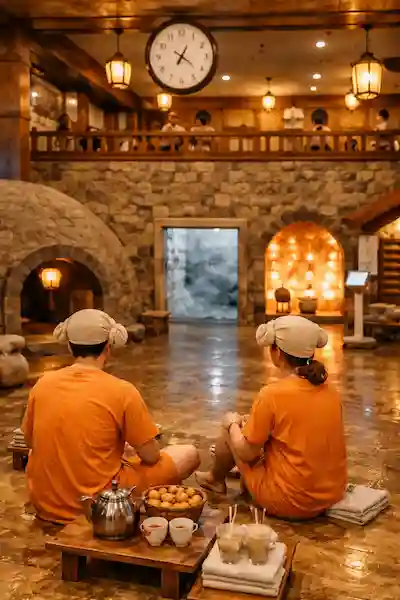
Jjimjilbang (찜질방) — Korean bathhouses — are another deeply Korean social institution that operates differently from visitor expectations shaped by Japanese onsen or Western spa culture. A jjimjilbang is open 24 hours, costs around ₩12,000–₩15,000 for full access, and functions as a communal living space where Koreans sleep overnight, spend entire days, and conduct social life in a state of collective semi-undress with an ease that reflects generations of habitual use.
What a Jjimjilbang Contains
Beyond the bathing areas (separate gender-segregated pools with different temperatures — cold, warm, hot, often with specific mineral or wood-fired varieties), a full jjimjilbang complex typically includes: heated floor sleeping areas (the garak, where people sleep on thin mats wearing the provided cotton shorts and t-shirts), sauna rooms of different temperatures (the hwangtobang clay room is standard, alongside charcoal and salt rooms), a food court or snack bar serving Korean staples at any hour, an entertainment area with TVs and sometimes arcade games, a resting floor with recliners, and in larger establishments, a gym, a hair salon, and massage services.
The overnight option — staying until morning on the heated floor, sleeping among strangers who are also sleeping among strangers in an environment of complete mutual unselfconsciousness — is one of the most distinctly Korean experiences available to a visitor. It costs less than most hostels, the heated clay floor is genuinely comfortable, and waking up in a jjimjilbang at 6am surrounded by Koreans at various stages of their morning routine is a window into daily Korean life that no hotel, Airbnb, or tourist experience provides.
The Sikhye and Egg Ritual
The canonical jjimjilbang snack combination — sikhye (식혜) and a jjimjilbang egg — is specific to the bathhouse context and culturally embedded enough that most Koreans who visit a jjimjilbang have it automatically. Sikhye is a traditional sweet rice drink, lightly fermented, cold, and mildly sweet — the perfect post-sauna drink. The jjimjilbang egg is a hard-boiled egg that’s been cooked in the sauna environment at high heat for an extended period, turning the white a warm amber colour and developing a specific earthy flavour. Both cost ₩1,000–₩2,000 and are sold at every jjimjilbang’s snack counter. Eating them after a sauna session, sitting on a mat on the heated floor, is the kind of specific sensory experience that becomes a fixed Korea memory.
PC Bangs and Gaming Culture
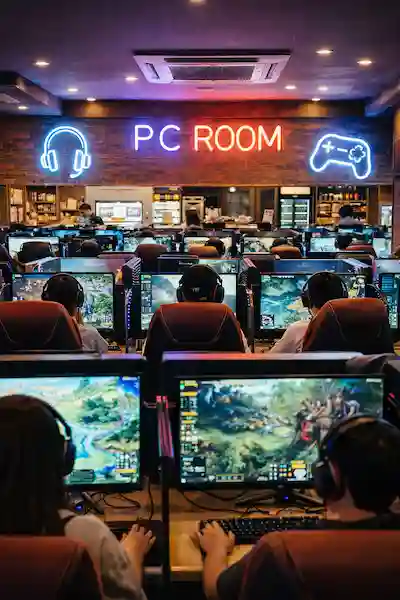
PC bang (PC방) — literally “PC room” — is the Korean gaming cafe: high-specification desktop computers rented by the hour in a dark, air-conditioned room with ramen and fried rice available from a kitchen at the back. Korea is one of the world’s premier gaming cultures — the country essentially invented the professional esports model, hosts major international tournaments, and has produced some of the world’s best competitive players across multiple titles. The PC bang is where that culture has its roots and where it still physically lives.
PC bangs cost around ₩1,000–₩2,000 per hour, are open 24 hours, and are used by a demographic wider than the stereotype suggests — yes, predominantly younger Korean men, but also mixed groups, people on lunch breaks running a quick gaming session, and occasionally foreign travellers who want to play at Korean gaming standards (the machines are significantly higher spec than most home setups) or just want to experience the specific atmosphere. The food available at PC bangs — typically a menu of Korean comfort foods ordered through a tablet system and brought to your station — is a legitimate meal option at 2am when most other things are closed.
Apps That Run Korean Daily Life in 2026
Understanding which apps Koreans use for daily life — and which of these are accessible to visitors — gives you a practical window into how Korean society is digitally organised.
KakaoTalk: The Operating System of Korean Social Life
KakaoTalk is used by over 95% of Koreans for messaging — not as one of several options, but as the primary and often only messaging platform anyone uses. Unlike WhatsApp or LINE, which exist alongside other apps, KakaoTalk has achieved a degree of social monopoly in Korea that means if you want to communicate with a Korean person in any context — booking a guesthouse, contacting a tour guide, staying in touch with someone you met travelling — the expectation is KakaoTalk. Download it, register with your international phone number, and use it as your primary Korea communication channel. The English interface is full and functional. Group chats, voice calls, video calls — all available without a Korean phone number.
Naver: Search, Maps, and Local Business
Naver is Korea’s dominant search engine — the Google of Korea in terms of market share, and significantly more than a search engine in terms of function. Naver’s ecosystem includes Naver Maps (covered in the navigation guide), Naver Blog (where Koreans write detailed personal reviews of restaurants, travel experiences, and products that are the most trusted domestic recommendation source), Naver Cafe (forum-style communities organised by interest and locality), and Naver Shopping (the dominant e-commerce platform). Understanding that Korean online information lives primarily on Naver rather than Google explains why searching for Korean local information in English on Google often returns tourist content rather than local reality.
Baemin and Coupang Eats: Delivery Culture
Korea’s food delivery culture is among the most developed in the world — delivery apps (Baemin and Coupang Eats dominate) deliver to apartments, offices, parks, and, as mentioned above, specific GPS coordinates along the Han River. In 2026, Baemin’s English interface has improved enough to be usable by visitors, though it requires a Korean phone number for full registration. The delivery economy it supports is remarkable in scale: an estimated 30% of Korean meals are delivered rather than eaten at the restaurant or prepared at home, a proportion that reflects both the density of the apartment population and the extraordinary efficiency of Korean delivery infrastructure — average delivery time in Seoul is under 25 minutes.
Karrot (Danggeun Market)
Karrot (당근마켓, Danggeun Market) is Korea’s dominant second-hand marketplace app — a hyperlocal classifieds platform where Koreans buy and sell used goods within their immediate neighbourhood. As a tourist, you’re not going to be buying second-hand furniture through Karrot, but browsing it as a window into Korean daily life has a particular quality: you see what people in a specific neighbourhood are selling and buying, the prices of ordinary Korean goods, the texture of domestic Korean life as revealed through what people choose to pass on. It’s also how Koreans find local services, trade community information, and ask neighbourhood-specific questions. Even without a Korean language interface, Karrot’s visual search function gives you a scroll through what Korean daily commercial life actually looks like at a granular level.
The Late Night Economy: Korea After Midnight

Korean cities don’t sleep — not in the performed sense of a city that keeps some bars open late, but in the genuine sense of a population that organises significant portions of its social life after midnight by cultural habit.
The reasons are partly structural: Korean work culture has historically involved long evenings of mandatory company socialising (hoesik — the company dinner that extends into drinking that extends into noraebang), meaning the actual social night often begins at 10pm. University culture runs on late schedules — libraries, study cafes, and convenience stores around major campuses are busiest between 11pm and 2am during exam season. The delivery economy operates at full speed through the night; the 24-hour convenience store is exactly as busy at 2am as at 2pm in many neighbourhoods.
Hongdae and the Late Night Neighbourhood Structure
Different Seoul neighbourhoods have different late-night cultures and different peak times. Hongdae (around Hongik University) peaks between 11pm and 3am on weekends — the area around the main street and the smaller alleys running off it contains the densest concentration of bars, live music venues, clubs, street performers, and 24-hour restaurants in Seoul. The demographic skews young (university students and early-20s), the music ranges from K-pop bleed from karaoke bars to indie live performances to electronic music from basement clubs, and the energy is genuinely electric on a Friday or Saturday night.
Itaewon — traditionally the most internationally diverse neighbourhood in Seoul, historically tied to the US military base community — operates a different late-night culture: more mixed-age, more internationally oriented, with a higher proportion of non-Korean visitors and residents. The neighbourhood has undergone significant transformation since the Itaewon crowd crush of 2022 (which claimed 159 lives), with narrower alleys now managed with pedestrian flow controls and much greater official attention to crowd density during peak nights. It remains an active nightlife district but with a different atmosphere than pre-2022.
The 24-Hour Study Cafe
One specifically Korean late-night institution: the 24-hour study cafe (스터디 카페, study cafe). These are silent-rule, individually partitioned study spaces available for hourly or daily rental — think of a library crossed with a co-working space crossed with a vending machine cafe, open continuously regardless of hour. They’re used by university students preparing for exams, professionals studying for certification exams, and anyone who needs a quiet, well-lit space to concentrate at 3am. The hourly rate (typically ₩2,000–₩3,000) includes a locker for your bag and often free coffee or snacks. Study cafes are everywhere in Korean university neighbourhoods and increasingly in commercial areas. For a traveller who needs to get work done at an odd hour, they’re the best option in Korea — quiet, cheap, open, and with fast WiFi.
Jeong: The Emotional Logic of Korean Connection
Jeong (정) is one of the most important Korean cultural concepts and one of the hardest to translate. It describes the bond of affection, attachment, and loyalty that develops between people (and between people and places) through shared time, shared meals, and shared experience. Jeong is not romantic love — it applies to friends, family, neighbours, and even to places or objects that have been part of a person’s life for a long time. The phrase “jeong-i deuneun” means “jeong is developing” — describing the feeling when a connection is becoming something that matters.
Jeong explains several Korean social behaviours that visitors often find surprising:
- Why Korean hosts are so insistent about feeding you: Sharing food is how jeong is built. Offering food — particularly home-cooked food — is an act of jeong expression, not just hospitality. Refusing food from a Korean host requires very gentle handling because it can read as rejection of the connection being offered.
- Why Korean friendships often involve intense levels of contact: Jeong-based relationships carry obligations — you check in on people, you make effort across distance, you show up. The Korean friend who texts you every few days and shows up with food when you’re sick isn’t being intrusive; they’re expressing jeong.
- Why Koreans often feel melancholy about places that are changing: Jeong with a neighbourhood, a building, or a regular haunt is a real emotional phenomenon. The sadness when a favourite market stall closes or a regular café is converted into something else isn’t nostalgia in the Western sense; it’s jeong dissolving, which is a distinct emotional experience in Korean culture.
For a visitor, the practical implication of jeong is that Korean hospitality — when it’s genuine, not commercial — tends toward the personal rather than the formal. The guesthouse owner who invites you to eat breakfast with them isn’t overstepping; they’re being Korean. The market vendor who gives you an extra piece of hotteok because you’ve been coming back every morning isn’t making a business decision; they’re building jeong. These moments are the texture of K-Life that no itinerary can prescribe but that emerge naturally from spending time in the same places with the same people over consecutive days.
Frequently Asked Questions

Can I experience K-Life outside Seoul?
Yes, and in some ways more genuinely. Seoul’s K-Life is polished and partially optimised for consumption — the content version of Korean daily life is most visible there because that’s where most content is created. Busan’s daily rhythm is different: slower-paced, more physically rooted in the sea and the mountains, with a warmth of personality that Seoulites themselves acknowledge as distinctively Busan. Gyeongju has hanok-district daily life — a living traditional neighbourhood where residents go about their routines surrounded by a thousand years of architectural history. Gangneung since the KTX-Eum has become more accessible and offers a coastal daily rhythm built around the sea, local seafood markets, and a coffee culture (Gangneung has an extraordinary number of specialty coffee roasters for its size) that reflects the city’s specific geography and character.
Do I need to speak Korean to live like a local?
Not fluently, but a handful of specific words and phrases makes a significant difference. “Kamsahamnida (감사합니다)” — formal thank you — and “Gomapseumnida (고맙습니다)” — warmer, more personal thank you — are worth knowing. “Olmayeyo (얼마예요)?” — how much? — is essential at markets. “Masiteo sseo yo (맛있어요)” — it was delicious — after a meal generates visible warmth from Korean hosts and restaurant staff. Papago (Naver’s translation app) and Google Translate’s camera translation function handle everything else — menus, signs, product labels — well enough for daily life navigation. The language gap is real but not a barrier to genuine K-Life experience; the gesture of trying a few Korean words and phrases matters more than the grammar.
What is hoesik and should I join one if invited?
Hoesik (회식) is the Korean company dinner — a structured social meal where colleagues eat and drink together, typically after work, that functions as a workplace bonding ritual. It’s more obligatory than a Western “team dinner” and historically more extended, often continuing through multiple rounds at different venues (the 1차/2차/3차 system — first, second, third round). If you’re in Korea on an extended stay or working with a Korean team and get invited to hoesik, it’s worth attending for the cultural experience even if you don’t drink — the context will tell you more about Korean professional social culture in three hours than a week of sightseeing. The appropriate behaviour is to show up, participate in the shared food, receive drinks poured by colleagues with both hands, and stay for at least the first round before excusing yourself gracefully if needed.
What is the Visit Korea Year 2026 benefit for tourists?
The extended Visit Korea Year campaign offers specific discounts and free entry benefits for foreign passport holders at national museums, certain cultural sites, and select festivals throughout 2026. The Korea Tourism Organisation (KTO) maintains a current list on their official website (visitkorea.or.kr) — it’s worth checking before major cultural site visits as the list changes throughout the year. The Climate Card transit pass has also been priced specifically to benefit international visitors during the Visit Korea Year period. Some private attractions and festivals offer additional foreigner discounts on presentation of a foreign passport — ask at the ticket window even when this isn’t posted, as it’s sometimes available without being advertised.
Neighbourhood Exploration: How Koreans Actually Use Their City

Korean cities are organised around dong (동) — administrative neighbourhood units that also function as genuine social communities. The dong is the scale at which Korean daily life actually operates: the bakery you’re loyal to, the market you go to on Saturday mornings, the park where the neighbourhood’s children play, the pharmacist who knows your name. Understanding the dong as the primary unit of Korean urban life — rather than the city, which is too large, or the block, which is too small — gives you a more useful mental map for exploring.
Seoul’s Neighbourhood Character
Seoul’s most well-known neighbourhoods each have a genuinely distinct character that reflects their history and current demographic:
- Seongsu-dong: Seoul’s former leather and manufacturing district, now the highest concentration of concept cafes, independent fashion labels, and creative industry studios in the city. The industrial infrastructure — exposed brick, concrete, loading docks — is preserved as aesthetic rather than demolished. The energy is young, creative, and self-consciously cool in a way that is specific to Seongsu’s particular gentrification trajectory.
- Seochon and Buam-dong: The villages on the western flank of Gyeongbokgung Palace — quieter, more literary, with independent bookshops, small galleries, and the specific character of a neighbourhood where the old built environment has been inhabited rather than renovated. Traditional hanok buildings converted to cafes sit alongside lived-in residential streets with the same house forms still operating as ordinary homes.
- Mangwon-dong: The neighbourhood around Mangwon Market on the Han River’s north bank — one of the last intact traditional market neighbourhoods within easy transit reach of central Seoul. Less tourist-facing than Hongdae despite being adjacent; the market and surrounding streets have a daily-life texture that Hongdae has largely traded for nightlife.
- Mullae-dong: Seoul’s metalworking and small manufacturing district near Yeongdeungpo, where indie art studios, music rehearsal spaces, and small galleries have established themselves in the gaps between still-operating workshops. A working neighbourhood with an art overlay rather than a gentrified neighbourhood with a craft narrative.
The Practice of Dong Exploration
The most rewarding way to explore a Korean neighbourhood is to arrive with almost no plan — a starting point (a specific cafe, a market, a subway exit) and a rough direction — and walk slowly, taking the streets that look lived-in rather than the ones that look curated. The interesting moments in Korean neighbourhood life happen in the gaps between the official attractions: the grandmother tending plants on a rooftop terrace, the school letting out with the specific organised chaos of Korean children in uniform, the pojangmacha setting up at dusk with the practised routine of many hundreds of identical evenings. None of this is scheduled, photographed, or on any itinerary. It accumulates into an understanding of a place that the landmark tour never produces.
Common Mistakes When Trying to Live Like a Local

K-Life tourism has its own failure modes — ways of pursuing “authentic local experience” that produce the opposite of the intended result.
Treating Every Experience as Content
The Korean daily life that travels well on social media is a curated selection of the most photogenic moments of Korean daily life. Experiencing Korea primarily through the lens of what will perform on TikTok or Instagram produces a relationship with the country that is real but shallow — you’ve seen the aesthetic; you haven’t experienced the place. The jjimjilbang floor at 6am isn’t photogenic. The Tuesday afternoon in a neighbourhood that nothing remarkable happens in isn’t photogenic. These are often the experiences that produce the strongest memories and the deepest sense of actually having been somewhere.
Staying Only in Tourist-Oriented Accommodation
The type of accommodation you choose significantly affects your access to K-Life. A hotel in Myeongdong puts you in the most tourist-dense neighbourhood in Seoul, surrounded by other tourists, with Korean daily life happening mostly elsewhere. A guesthouse in Mangwon-dong, a hanok stay in Bukchon or Seochon, or an Airbnb in a residential neighbourhood in Mapo-gu puts you in a context where the daily rhythms of Korean life are immediately visible — the same convenience store the neighbours use, the same breakfast options, the same morning sounds. The accommodation choice is the framework within which all other experience happens.
Rushing the Schedule
Korean daily life has its own pace — unhurried in the parts that are supposed to be unhurried, intensely fast in the parts that are about transit and efficiency. Tourist schedules that try to hit five neighbourhoods in a day match neither rhythm. The market in the morning, one neighbourhood in the afternoon, the Han River in the evening, a noraebang at night — this is a full day, done well. Adding three more destinations makes it a transportation exercise rather than a life experience. The gap between having been somewhere and having experienced somewhere is usually time.
📷 Featured image by Mathew Schwartz on Unsplash