On this page
- August Days Are for Hiding. August Nights Are for Korea.
- Why August Nights Hit Different in Korea
- Seoul’s Rooftop Bar Scene in 2026
- Han River Night Culture
- Hongdae After Midnight
- Busan’s Summer Night Scene
- Night Food Markets and Street Eats
- 2026 Budget Reality for Summer Nightlife
- Frequently Asked Questions
August Days Are for Hiding. August Nights Are for Korea.
August in South Korea hits hard. Daytime temperatures regularly sit between 33°C and 37°C, and the humidity makes it feel worse. If you arrive expecting to power through palaces and markets in the afternoon heat of 2026, you will burn out fast. The smart move — and what locals have always known — is to invert your schedule completely. Sleep through the hottest hours. Eat something cold. Then step outside around 8pm when the city finally exhales, and you will find a version of Korea that most visitors completely miss.
Why August Nights Hit Different in Korea
Korean summers have always pushed social life outdoors after dark, but in recent years that pattern has become more deliberate and more designed. The concept of 열대야 (yeoldaeya) — tropical nights where temperatures stay above 25°C even after midnight — is now a regular feature of Seoul summers, and Koreans have built a whole culture around surviving and enjoying them.
Walking through Itaewon or Sinchon after 9pm in August, the air smells of grilled meat drifting down from open restaurant windows, and you hear the sound of ice clinking in tall glasses of beer. Every convenience store — and there are thousands of them — sets up plastic tables and stools on the pavement. People sit outside until 1am or 2am eating ramen, drinking soju, and watching the street. It is completely ordinary. It is also one of the best things about being in Korea in summer.
The nightlife infrastructure here supports late hours in a way that few countries match. Transport, food delivery, convenience stores, street vendors, night markets — all of it runs deep into the night. For a visitor arriving in August 2026, the city does not close on you. It just gets better.
Seoul’s Rooftop Bar Scene in 2026
Seoul’s rooftop bar culture has matured significantly over the past few years. Where once you had a handful of hotel terraces with overpriced cocktails, the city now has rooftop options across most major neighbourhoods, ranging from casual beer-and-chicken spots to genuinely impressive cocktail bars with views of N Seoul Tower or the Han River.
Itaewon and Hannam-dong remain the densest cluster for rooftop options. The hillside geography here means that even second-floor terraces can feel open and elevated. Hannam-dong in particular has developed a more polished, local crowd — less of a tourist strip, more of a neighbourhood enjoying itself.
Euljiro (을지로) is worth attention in 2026. The area’s blend of old printing shops and industrial spaces has attracted a wave of creative bars and venues, many of which operate on rooftops or semi-open terraces. The aesthetic is raw and interesting. The drinks are usually cheaper than in Itaewon.
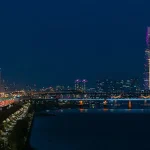
Yeouido becomes its own universe on summer nights. Sitting along the Han River, the neighbourhood draws huge weekend crowds, and rooftop spots here let you watch the river lights while a warm breeze comes off the water. It sounds like a cliché until you are actually sitting there.
Budget roughly 15,000–25,000 KRW (~$11–$19 USD) per cocktail at mid-range rooftop bars. Hotel rooftops can run 25,000–40,000 KRW (~$19–$30 USD) per drink but often include the best views in the city.
Han River Night Culture
The Han River parks at night in August are something you should experience at least once. Locals arrive with convenience store bags stuffed with fried chicken, beer, and snacks, claim a spot on the grass or a rental mat, and settle in for hours. This is chimaek culture — chicken and beer (맥주) — in its most natural habitat.
Several of the Han River park areas have food kiosks and rental services operating late into the evening. You can rent a mat, buy food on-site, or walk five minutes to the nearest convenience store. Night cycling paths along the river are also well-lit and popular. The combination of a cool breeze off the water, the distant glow of apartment blocks reflected in the river, and the low hum of conversation all around you is hard to replicate anywhere else.
Yeouido Hangang Park and Ttukseom Resort area are two of the most popular spots for this. Both are easily reached by subway. On weekend nights in August, expect large crowds but also a genuinely festive atmosphere. Vendors and pop-up food stalls often appear on summer weekends, though specific schedules vary by year.
Hongdae After Midnight
Hongdae (홍대) is the anchor of Seoul’s youth nightlife and has been for decades. What has shifted in recent years is the scene’s texture. The area directly around Hongik University station still draws massive crowds, but the interesting stuff increasingly happens in the surrounding streets — Yeonnam-dong, Sangsu-dong, and the quieter lanes between them.
Street performances (버스킹) happen nightly in designated areas near exit 9 of Hongik University station. In August, the warm nights mean performances run longer and draw bigger crowds. You might hear a solo acoustic set, a full band, or a K-pop cover group with a production setup that puts some small venues to shame. The sound carries down the street, and the crowd forms and dissolves organically — it costs nothing to watch.
Club culture in Hongdae is real and active. Entry fees for most clubs run between 10,000 and 20,000 KRW (~$7–$15 USD), often including a drink. Fridays and Saturdays draw the biggest crowds, but Thursday nights have a strong following with a slightly older, more local crowd. Most clubs run until 5am or 6am on weekends.
One practical note for 2026: carry cash. Many smaller venues and street food stalls around Hongdae still prefer it, even as card acceptance has improved broadly across Seoul.
Busan’s Summer Night Scene
If Seoul is the engine of Korean nightlife, Busan is the beach holiday version — louder in some ways, more relaxed in others. August is high season for Busan, and the coastal energy is completely different from the capital.
Gwangalli Beach is the centrepiece of Busan’s summer nights. The beach itself stays busy after dark, with people sitting on the sand or at the bars and restaurants that line the strip. The Gwangan Bridge lights up at night and provides a backdrop that is genuinely dramatic — especially from the beach at 10pm with a cold drink in hand. The sound of waves underneath the noise of the crowd creates an atmosphere that Seoul simply cannot replicate.
Haeundae is more resort-like and more expensive. It draws a larger tourist crowd in August and the beach is packed. The nightlife here tends to centre on hotel bars and the main strip rather than independent venues.
For something more local and less polished, the area around Millak Waterside Park and the streets near Gwangalli subway station have smaller bars and pojangmacha (포장마차) street stalls that run late and cater heavily to Korean locals rather than visitors.
Night Food Markets and Street Eats
August is one of the best times to eat outdoors in Korea — not because the weather is comfortable (it is not), but because the food culture comes alive at night. Pojangmacha stalls, covered in orange tarpaulins and lit by bare bulbs, sell tteokbokki, sundae, hotteok, corn dogs, and grilled skewers. You order standing up, eat fast, and move on.
The smell of tteokbokki sauce reducing on a flat pan — slightly sweet, deeply spicy, with the rubber-soft chew of rice cakes — is one of those August-in-Korea sensory markers that is difficult to forget.
Night markets vary by city and neighbourhood. In Seoul, the Dongdaemun area stays active extremely late due to its wholesale fashion markets, and the surrounding street food scene reflects that — vendors operate from roughly 9pm to 4am catering to workers and shoppers. In Busan, the Jagalchi area near the fish market also has evening street food, with fresh seafood options you will not find inland.
For night food, budget 3,000–8,000 KRW (~$2–$6 USD) per item at street stalls. A full meal at a pojangmacha might cost 10,000–15,000 KRW (~$7–$11 USD) including a drink.
2026 Budget Reality for Summer Nightlife
Korea is not as cheap as it was five years ago, but it is still very manageable compared to Japan or Western Europe in 2026. Here is a realistic breakdown for a summer night out:
- Budget night out: Convenience store drinks and snacks at the Han River or a pojangmacha crawl — 10,000–20,000 KRW (~$7–$15 USD) per person for the whole evening.
- Mid-range night out: A sit-down chimaek restaurant, one or two drinks at a Hongdae bar, entry to a club — 50,000–80,000 KRW (~$37–$59 USD) per person.
- Comfortable night out: Rooftop cocktail bar, dinner at a proper restaurant, late-night dessert cafe — 100,000–160,000 KRW (~$74–$119 USD) per person.
Transport costs are low and consistent. A single subway trip runs around 1,400–1,600 KRW (~$1–$1.20 USD) with a T-Money card. Taxis are metered and generally honest. Late-night rideshare apps (Kakao T is the most widely used) work reliably and show the fare estimate before you confirm — useful when you want to skip the late-night subway crowd.
The T-Money card tap at the subway gate is one of those small but satisfying sounds of a Seoul night — a clean beep that tells you the city is still moving, still open, still running on your schedule.
Frequently Asked Questions
Is August a good time to visit South Korea for nightlife?
Yes — August is one of the best months for nightlife specifically because the heat pushes activity into the evening. Streets, parks, bars, and markets stay busy well past midnight. The trade-off is high humidity and hot days, so plan your schedule around late evenings to get the most out of your time.
How late does public transport run in Seoul in August 2026?
Seoul’s subway typically runs until around midnight on weekdays and slightly later on Friday and Saturday nights. If you are out past that, Kakao T taxis are widely available, affordable, and show fare estimates upfront. Most major nightlife areas are well served by both options.
Is Busan or Seoul better for summer nightlife?
They offer genuinely different experiences. Seoul has more variety — rooftop bars, club districts, night markets, river parks — while Busan offers beach nightlife with a coastal atmosphere. If you have time, do both: Seoul for depth, Busan for a completely different summer energy centred on Gwangalli Beach.
What should I wear for a night out in Korea in August?
Light, breathable clothing is essential — linen or moisture-wicking fabrics work best. Clubs and upscale rooftop bars may enforce smart-casual dress codes, so avoid flip-flops and beachwear in those settings. Most casual bars and street venues have no dress restrictions. Carry a small bag; nights tend to go long.
Do I need to book in advance for rooftop bars in Seoul?
For popular rooftop bars on Friday and Saturday nights in August, a reservation is strongly recommended. Many venues allow walk-ins on weeknights but fill up fast on weekends. Check the venue’s social media or Naver reservation pages — most well-known spots in Seoul have booking systems available in Korean and sometimes English.
Explore more
South Korea in July 2026: Savoring Samgyetang for Summer Wellness
South Korea’s Monsoon Season: Essential Tips for July 2026 Travel
South Korea’s Summer Staple: Staying Cool with Bingsu in July 2026
📷 Featured image by Red Shuheart on Unsplash.