On this page
- What Makes Jeonju Hanok Village Different from Other Hanok Sites
- The Village Layout: How to Orient Yourself on Arrival
- Where to Eat: Jeonju’s Food Scene Is the Real Attraction
- Sleeping Inside the Village: Hanok Stays Explained
- Day Trip or Overnight? An Honest Assessment
- Getting There from Seoul and Busan in 2026
- Getting Around Jeonju Once You Arrive
- 2026 Budget Reality: What Things Actually Cost
- Beyond the Postcard: Lesser-Known Spots Worth Finding
- Practical Tips Before You Go
- Frequently Asked Questions
💰 Click here to see Korea Budget Breakdown
💰 Prices updated: 2026-10-01. Budget figures are estimates — always verify before travel.
Exchange Rate: $1 USD = 1,356 KRW
Daily Budget (per person) • Pricing updated as of 2026-10-01
Daily Budget
Shoestring: 60,000 KRW - 95,000 KRW ($44.25 – $70.06)
Mid-range: 130,000 KRW - 250,000 KRW ($95.87 – $184.37)
Comfortable: 350,000 KRW - 550,000 KRW ($258.11 – $405.60)
Accommodation (per night)
Hostel/guesthouse: 25,000 KRW - 65,000 KRW ($18.44 – $47.94)
Mid-range hotel: 90,000 KRW - 165,000 KRW ($66.37 – $121.68)
Food (per meal)
Budget meal (street food): 9,000 KRW ($6.64)
Mid-range meal (restaurant): 22,000 KRW ($16.22)
Upscale meal: 65,000 KRW ($47.94)
Transport
Single subway/bus trip: 1,600 KRW ($1.18)
Climate Card (30-day unlimited): 67,000 KRW ($49.41)
What Makes Jeonju Hanok Village Different from Other Hanok Sites
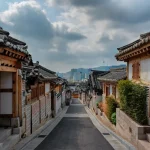
By 2026, Korea‘s hanok tourism has exploded. Bukchon in Seoul is perpetually overrun, Gyeongju has its crowds, and every second city has opened some kind of “traditional village” attraction. Against this backdrop, Jeonju Hanok Village stands apart — not because it’s been dressed up for tourists, but because around 800 households actually live here. People hang laundry between tiled roofs. Grandmothers argue over the price of tofu at the morning market. The village breathes.
That said, the main strip near Gyodong Catholic Cathedral gets genuinely packed on weekends, especially since the KTX travel time from Seoul dropped below two hours in late 2024. If you show up at 11am on a Saturday without a plan, you’ll spend your morning shuffling through selfie traffic. This guide is built around helping you avoid that.
The Village Layout: How to Orient Yourself on Arrival
Jeonju Hanok Village sits in the Wansan district of Jeonju city, about 15 minutes by taxi from Jeonju KTX Station. The village itself covers roughly 0.47 square kilometres, but the surrounding food and cultural streets extend it considerably in every direction.
The easiest mental map breaks it into three zones:
- Central strip (Gyodong area): The most photographed stretch, running from Gyodong Catholic Cathedral past the row of hanbok rental shops toward Namsanjae. This is where the crowds concentrate. Beautiful, but busy.
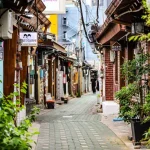
- Western residential lanes: Duck left off the main strip within five minutes of entering and the crowds thin dramatically. These narrow alleys pass actual homes, small studios, and local-run guesthouses. The walls are lower here and the rooflines feel more intimate.
- Eastern cultural zone: Home to Jeondong Cathedral (a surprisingly striking Romanesque structure built in 1914), the Jeonju Crafts Exhibition Hall, and the Traditional Wine Museum. More deliberate and museum-paced than the central strip.
The village is entirely walkable once you’re inside. There are no cars on the main pedestrian lanes, which is part of what makes an early morning wander — before the rental shops open — feel genuinely calm. The sound of wind through the pine trees along the ridge path behind Omokdae Pavilion is one of those small pleasures that doesn’t make it into any brochure.
Where to Eat: Jeonju’s Food Scene Is the Real Attraction
There’s a real argument that people come to Jeonju Hanok Village primarily to eat, and that the architecture is a pleasant bonus. Jeonju is the undisputed capital of Korean food culture — it’s the city that claims to have invented bibimbap, that hosts the annual Jeonju Bibimbap Festival, and whose local cuisine holds a level of civic pride that borders on competitive. Locals will tell you, with complete sincerity, that Jeonju bibimbap tastes different here because of the local water and the quality of the Jeollabuk-do sesame oil. They’re not entirely wrong.
Bibimbap
The landmark spot for traditional bibimbap is Gajok Hoegwan (가족회관) on Gongpyeong-ro, a short walk from the village entrance. It’s been operating since 1952 and still uses stone bowls (dolsot) that arrive at the table crackling hot. The banchan spread — 15 to 20 small dishes before you’ve even touched the main event — arrives on a brass tray and covers the entire table. Lunch here costs around 15,000–18,000 KRW per person (~$11–13 USD). Cash is still preferred though card is now accepted.
Makgeolli and Pajeon

Jeonju’s makgeolli (milky rice wine) bars cluster along the streets behind the central strip. The tradition here is that when you order makgeolli, the food comes automatically — pajeon (green onion pancake), dubu kimchi, and whatever the house is making that day. You pay only for the drinks. This isn’t a tourist gimmick; it’s a genuinely old Jeonju custom. Sambaek-jip (삼백집) is the most famous practitioner of this tradition and has been since 1952. A round of makgeolli for two with full side dishes runs about 12,000–16,000 KRW (~$9–12 USD).
Street Food on the Main Strip
The central strip is lined with vendors selling items that range from outstanding to deeply average. The ones worth stopping for: choco-pie hotteok (a Jeonju twist on the classic sweet pancake, filled with chocolate and nuts), sundubu (soft tofu) served in small cups with broth, and freshly made omijacha (five-flavour berry tea) that smells like dried roses and tastes slightly sweet and tart. Skip the generic tornado potatoes and corn dogs — those are everywhere in Korea.
Kongnamul Gukbap
This is the local hangover cure and beloved breakfast: a simple bowl of rice in broth loaded with beansprouts. It’s lighter than it sounds and deeply comforting. Hyundae Okryugwan near the market area serves a reliable version for around 8,000 KRW (~$6 USD). Open from early morning.
Sleeping Inside the Village: Hanok Stays Explained
Staying overnight in the village means sleeping in a hanok guesthouse — a converted traditional home with ondol floor heating (underfloor radiant heat), low wooden furniture, and paper screen doors that let in the morning light in a way that feels nothing like a hotel. Most rooms are floor-based; you sleep on a yo (padded mat) rather than a bed. If that’s a concern for your back, ask specifically for a property with raised sleeping platforms when booking.

The village has roughly 80 registered hanok guesthouses in 2026, ranging from basic backpacker-friendly spots to high-end renovated properties with private courtyards and premium bedding. Quality is uneven. The most consistently praised properties are clustered on the quieter western lanes rather than directly on the main tourist strip — those fronting the central street tend to get noise from late-evening visitors.
What to expect regardless of price tier:
- Shared bathrooms are common at budget-to-mid level properties. Private ensuite bathrooms come at a premium.
- Breakfast (usually kongnamul gukbap or simple Korean fare) is sometimes included and sometimes not — confirm at booking.
- Wi-Fi is standard across all tiers as of 2026.
- Check-in is typically from 3pm, and the properties are small — there’s rarely a lobby to wait in.
Booking through Naver Stay or Yanolja (both apps now have functional English interfaces in 2026) often surfaces smaller family-run guesthouses that don’t appear on international platforms. These tend to offer more authentic experiences and sometimes include a brief orientation from the host about the neighbourhood.
Day Trip or Overnight? An Honest Assessment
This question genuinely depends on what you’re here for.
A day trip works if: you’re primarily interested in seeing the architecture and eating well, you’re travelling from Seoul and are comfortable with back-to-back KTX rides, and you’re willing to hit the village by 9am and use your afternoon efficiently. A well-planned day gives you the main village, a proper bibimbap lunch, the cathedral exterior, a makgeolli stop, and some street food before your evening train home. It’s a full and satisfying day.
Overnight is better if: you want the early morning experience (which is genuinely transformative), you’re interested in the surrounding Jeollabuk-do region (Maisan Provincial Park and the fortress walls of Geumsansa Temple are both within an hour), you want to eat across multiple meals without rushing, or you simply want to experience the village after dark when paper lanterns light the lanes and the tourist crowds have thinned to almost nothing.

The honest answer for most travellers: one night is the sweet spot. Two nights starts to feel repetitive unless you’re building out day trips into the wider Jeollabuk-do region, which is genuinely rewarding but requires more planning.
Getting There from Seoul and Busan in 2026
From Seoul
The KTX from Seoul Yongsan Station to Jeonju Station takes approximately 1 hour 45 minutes on the fast services, and under 2 hours on all standard runs. Trains depart frequently throughout the day. A one-way ticket in standard class costs around 27,000–38,000 KRW (~$20–28 USD) depending on the service and how far in advance you book. The SRT from Suseo Station is slightly cheaper and worth checking if you’re coming from the southeastern parts of Seoul.
From Jeonju KTX Station to the Hanok Village, take a taxi (around 8,000–10,000 KRW, ~$6–7 USD, and about 15 minutes) or bus line 79 or 999, which drops you close to the village entrance for 1,500 KRW (~$1.10 USD). The bus takes 25–30 minutes but is a fine option if you’re not in a rush.
From Busan
The KTX from Busan to Jeonju involves a transfer at Iksan or Jeonju is reached via a change at Osong. Total journey time is 2 hours 15 minutes to 2 hours 45 minutes depending on the connection. Alternatively, intercity buses from Busan Central Bus Terminal run directly to Jeonju Bus Terminal in about 2.5 hours and cost around 17,000–20,000 KRW (~$13–15 USD). From Jeonju Bus Terminal, the Hanok Village is a 10-minute taxi ride.
Getting Around Jeonju Once You Arrive
Inside the village, you walk. That’s it. The lanes are too narrow for anything else, and the entire core is pedestrian. What matters is getting between the village and other parts of Jeonju city.

Jeonju has a city bus network and taxis. Kakao T (the dominant ride-hailing app in Korea) works well here and all drivers accept card payment. Bus routes within the city cost 1,500 KRW (~$1.10 USD) per ride with a T-Money card — the satisfying tap and beep as you board is the same ritual you’d use in Seoul. Load your T-Money card at any convenience store.
In 2026, Jeonju introduced a small network of electric kickscooters (operated by Gcooter and Kickgoing) that are practical for reaching the Nambu Traditional Market or the river promenade, both of which are about 1.5–2 km from the village. Prices run about 200 KRW per minute (~$0.15 USD) after a base fee.
Bicycle rental is also available near the village entrance for flat-rate half-day or full-day hire — useful if you want to explore the Jeonju Cheon stream path or reach Deokjin Park.
2026 Budget Reality: What Things Actually Cost
Jeonju is notably affordable compared to Seoul and even compared to other Korean regional cities. Here’s an honest breakdown:
Accommodation (per room, per night)
- Budget: 40,000–70,000 KRW (~$30–52 USD) — basic hanok guesthouses, shared bathrooms, floor sleeping
- Mid-range: 80,000–130,000 KRW (~$59–96 USD) — renovated hanok rooms, often with private bathroom, better bedding
- Comfortable: 150,000–250,000 KRW (~$111–185 USD) — boutique hanok with courtyard, premium ondol, sometimes breakfast included
Food
- Budget meal (kongnamul gukbap, street food): 4,000–9,000 KRW (~$3–7 USD)
- Sit-down traditional meal (bibimbap with banchan): 12,000–20,000 KRW (~$9–15 USD)
- Makgeolli session for two with food: 14,000–22,000 KRW (~$10–16 USD)
Activities and Extras
- Hanbok rental (3–4 hours): 15,000–25,000 KRW (~$11–19 USD), includes hair styling at most shops
- Hanji (traditional paper) craft workshop: 10,000–20,000 KRW (~$7–15 USD)
- Traditional Wine Museum entry: 2,000 KRW (~$1.50 USD)
- Jeonju Crafts Exhibition Hall: free
A realistic one-night trip budget for two people — including return KTX tickets from Seoul, one night in a mid-range hanok, two proper meals, some street food, and a makgeolli session — lands around 350,000–450,000 KRW total (~$260–333 USD). That’s competitive with a night in any decent Seoul hotel for one person.

Beyond the Postcard: Lesser-Known Spots Worth Finding
Most visitors orbit the central strip, eat bibimbap, rent a hanbok, take photos, and leave. That’s a fine experience. But the village rewards people who wander slightly further.
Omokdae and Imokdae Pavilions
These two hillside pavilions sit above the village’s northern edge and require a 10–15 minute uphill walk on stone steps. From the top, you get an unobstructed view across the entire sweep of tiled rooftops with the Jeonju cityscape behind them. Almost nobody else is up here during the main visiting hours. The walk through the pines to reach them smells clean and cool even in summer.
Nambu Traditional Market
About 1.5 km south of the village, this covered market is a working local market rather than a curated tourist experience. The night market section (operating Thursday through Sunday evenings) is genuinely lively and sells regional food at prices well below what you’ll pay on the tourist strip. Worth the short taxi or scooter ride.
Jeonju Hanji Museum
Hanji — traditional Korean handmade paper — is a Jeonju specialty with a history stretching back to the Baekje kingdom. The museum near the village explains the production process through well-designed displays and offers workshops where you make your own sheet of hanji to take home. It’s understated and genuinely interesting, especially for families.
The Back Alleys at Night
After 8pm, the tour groups are gone. The hanok guesthouses glow softly from within. Small bars tucked into converted hanok rooms stay open late, and a few jazz and acoustic music spots have opened in the village since 2023. Walking the back alleys when the lanterns are lit and the crowds have cleared is a different village entirely from the daytime version.

Practical Tips Before You Go
- Weekdays are significantly less crowded than weekends. If your schedule is flexible, Tuesday through Thursday are the quietest days.
- The Jeonju Bibimbap Festival runs annually in October and brings substantial crowds but also cooking demonstrations, competitions, and food stalls that showcase regional ingredients. It’s worth planning around intentionally rather than accidentally encountering it.
- K-ETA is not required for visitors from 112 countries in 2026, following the permanent visa-exemption policy confirmed in early 2025. Check the Korean immigration website to confirm your country is included before travel.
- Most hanok guesthouses have a noise curfew or quiet hours starting around 10–11pm. The walls are thin and the community is residential. This is part of the experience, not a flaw.
- Korean mobile data is fast and cheap. A 10-day SIM from the airport or pre-ordered from a Korean provider like KT or SKT runs about 20,000–35,000 KRW (~$15–26 USD) in 2026. Google Maps now covers Jeonju Hanok Village’s internal lanes accurately following its 2025 map update for Korean regional cities.
- Hanbok rental shops are busiest from 10am to 2pm. Going at 9:30am when they open or after 3pm means shorter waits and more relaxed fittings.
- Card payment is accepted almost everywhere in the village in 2026, but a small amount of cash (20,000–30,000 KRW) is useful for older market stalls and traditional restaurants that still prefer it.
Frequently Asked Questions
How long should I spend at Jeonju Hanok Village?
One full day and one night is the ideal amount for most travellers. This lets you catch the quiet early morning, explore the village properly, eat across multiple meals, and experience the lanes after dark. A day trip from Seoul is doable but means missing the best parts of the experience — the morning and evening hours when the crowds are gone.

Is Jeonju Hanok Village free to enter?
Yes, the village itself has no entrance fee. You walk in freely from any direction. Individual museums and workshops have small entry fees (typically 2,000–10,000 KRW, or about $1.50–7.50 USD), and commercial activities like hanbok rental are paid separately. The Jeonju Crafts Exhibition Hall is free.
What is the best time of year to visit Jeonju Hanok Village?
Spring (April–May) and autumn (October–November) are the most visually rewarding seasons — cherry blossoms and maple colours against the grey tile rooftops are genuinely beautiful. Summer is hot and humid but the village handles it well. Winter visits are possible and surprisingly atmospheric, especially if it snows, though some smaller guesthouses close in January and February.
Can I wear hanbok in the village, and where do I rent one?
Wearing hanbok is extremely common and actively encouraged — many locals and visitors wear them throughout the day. Around 20 rental shops operate in and around the village, most concentrated near the main entrance area on Eunhaengno. Prices range from 15,000 to 25,000 KRW (~$11–19 USD) for 3–4 hours, and most shops include basic hair styling. No reservation is needed, but mornings are busy on weekends.
Is Jeonju Hanok Village accessible for travellers with mobility limitations?
The main central strip is flat and manageable with a wheelchair. The narrower residential alleys and the hillside paths to Omokdae Pavilion involve uneven stone surfaces and steps that are not wheelchair accessible. Hanok guesthouses, with their low thresholds and floor-level sleeping, can be physically challenging — contact properties directly to ask about their specific setup before booking.
Explore more
Why Jeonju is South Korea’s Best Food City (And What to Eat!)
Jeonju Travel Guide: Your Ultimate Foodie & Hanok Village Itinerary
Beyond Bulguksa: Discovering Gyeongju’s Hidden Historical Gems
📷 Featured image by Joshua Delica on Unsplash.