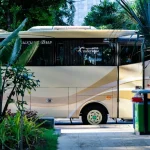
Every year, travellers land at Jeju Airport, see the long rental car queue, and wonder whether the bus can save them the hassle. In 2026, with international licence checks stricter and rental prices still high in peak season, it is a fair question. The short answer is yes, you can get around Jeju by bus, but only if you plan around its limits.
Can Buses Really Cover Jeju?
Jeju is a big island, about 73 km across east to west. The bus network reaches almost every town, beach and major attraction, but not always quickly. A trip that takes 25 minutes by car can take 70 minutes by bus once you add a transfer and a wait.
Buses work best for travellers who stay in one or two bases, such as Jeju City, Seogwipo or the Aewol coast, and pick two or three sights per day. They work poorly if you want to chase sunrise at one end of the island and sunset at the other. Think of the bus as a slow, cheap, scenic way to see fewer places well.
Understanding Jeju’s Colour-Coded Bus System
Jeju reformed its bus network in 2017, and the colour system still organises everything. You will see it on the bus body, the stop signs and the apps.
- Blue buses: trunk and express routes on main roads. They make fewer stops and connect the big hubs, such as Jeju City, Seogwipo and the airport. Route numbers are usually in the 100s and 200s.
- Green buses: branch routes that link villages, beaches and smaller attractions to the trunk lines. Numbers are usually in the 300s to 700s.
- Circular and special routes: some routes loop around towns, and the airport limousine (route 600) is a separate premium-style service.
The practical lesson is simple. Use a blue bus to cover long distances, then switch to a green one for the last stretch to your destination. Route numbers are adjusted from time to time, so confirm the number in an app on the day you travel.
Routes Visitors Actually Use
You do not need to learn the whole network. A handful of routes cover most tourist trips.
Airport to Jeju City
Jeju City is about 15 to 20 minutes from the airport by city bus. Several routes leave from the stops outside Arrivals, and the ride costs around 1,200 to 1,500 KRW (~$1). Taxis cost about 6,000 to 8,000 KRW (~$4.50–6) for the same trip.
Airport to Jungmun and Seogwipo
The airport limousine, route 600, runs to the Jungmun resort area and hotels along the way. It takes about an hour and costs several thousand won. Blue express buses also run between Jeju City and Seogwipo across the island, usually in 50 to 70 minutes depending on the route.

Island circle routes
Routes 101 and 102 are the long coastal circle services, running east and west around the island. They pass beaches, fishing villages and Seongsan on the east side. A full loop takes several hours, so treat it as a half-day ride with stops, not a quick transfer.
Popular sights by bus
- Seongsan Ilchulbong: use the east circle route, then walk from the nearest stop.
- Hallasan trailheads: buses run from Jeju City and Seogwipo to the Seongpanak and Eorimok areas. Check the first and last services before you climb.
- Hyeopjae and Hallim: the west circle route and connecting green buses serve the area.
- Jungmun and Cheonjeyeon Falls: take a blue or green bus from Seogwipo, or the 600 from the airport.
Fares and Payment in 2026
Local fares are low. Most city and local rides cost roughly 1,200 to 1,500 KRW (~$0.90–1.10). Longer trunk and express routes cost more, usually 2,000 to 3,000 KRW (~$1.50–2.20), and the airport limousine costs more again.
The easiest payment is a T-Money card, which works across Korea. You press it on the reader as you board, and a short beep confirms it. Tap again when you get off on routes that charge by distance, because the second tap closes your fare. Most foreign-issued contactless cards still do not work reliably on buses, so do not count on them. Cash is accepted on many buses, but you need exact or near-exact change, and cash fares are sometimes slightly higher than card fares.
Buy a T-Money card at the airport convenience stores (CU, GS25 or 7-Eleven) and load 10,000 to 20,000 KRW. Mobile T-Money is also available on some Android phones, but check compatibility before you rely on it.
Apps and Real-Time Info
Most stops have digital boards showing the next arrival times. These boards are accurate and make the system much easier to use than in the past. At smaller rural stops, you may only see a printed timetable.

For planning, Naver Map and Kakao Map remain the most reliable for Korean bus routes. They show live arrival times, stop names in Korean and English, and the exact stop to get off. Google Maps has improved its Korea coverage since 2024, but I still cross-check with Naver or Kakao on Jeju because rural frequencies can differ. Jeju also has its own bus information system and app, which is useful for checking timetables on less common routes.
Check the stop name in Korean as well as English. Announcements on board are in Korean, with English for major stops, and the recorded voice becomes easy to follow after a day or two. Also, watch the map dot, not just the audio, so you know when to press the stop button.
Where the Bus Falls Short
Buses struggle in specific situations, and it is better to know them before you arrive.
- Early sunrise trips: first buses often start too late for Seongsan sunrise from Jeju City. Stay near Seongsan the night before, or take a taxi for that one trip.
- Remote cafes and scenic spots: many popular places sit a 15 to 30 minute walk from the nearest stop, often along roads without pavements.
- Rural frequency: some green routes run only once an hour, or less often in the evening and on weekends.
- Bad weather: wind and heavy rain can delay buses and make the long walks unpleasant, especially in winter.
For these gaps, use a taxi for short hops. A taxi starts at around 4,000 KRW (~$3), and 10 to 15 minutes in a rural area often costs 10,000 to 15,000 KRW (~$7.50–11). Kakao T works in Jeju, but you may wait longer for a driver outside the main towns. Day charters with a taxi driver are another option if you want to see several distant places in one day, and the cost can be shared between the group.
2026 Budget Reality
Here is what getting around Jeju costs per person, per day, in 2026:
- Budget (buses only): 5,000 to 10,000 KRW (~$4–7) for three to six rides with a T-Money card.
- Mid-range (buses plus occasional taxis): 25,000 to 40,000 KRW (~$18–30), covering buses for main trips and taxis for remote last stretches or late returns.
- Comfortable (rental car or taxi charter): a small rental car runs about 60,000 to 100,000 KRW (~$45–75) per day outside peak season, plus fuel, parking and insurance. A full-day taxi charter costs 200,000 to 300,000 KRW (~$150–220) per vehicle.

Prices rise sharply in July, August, and during public holidays such as Chuseok and Lunar New Year, so rental cars may cost much more. For solo travellers and couples staying four or five days, buses plus a few taxis are usually the cheapest realistic combination.
Onboard Habits That Save You Stress
A few habits make the ride smoother, and they matter more on Jeju than in big cities because services are less frequent.
- Raise your hand at the stop. At quiet stops, drivers may not stop unless you signal them. This is especially true at small roadside stops.
- Press the stop button early. Press it as the previous stop is announced, not when your stop appears.
- Keep luggage small. Large suitcases are awkward on crowded routes. If you have big bags, the airport limousine or a taxi to your hotel is easier.
- Check the last bus. In rural areas, evening buses can end around 8 or 9 pm. Write down the last departure back to your base before you set off.
- Dress for the windows. In summer the air conditioning is strong, and in winter the windows fog up and the heating is warm. A light layer helps in both seasons.
Sit on the left side on the east circle route for ocean views, and keep your phone charged, because you will want the camera.
Frequently Asked Questions
Is it easy to travel around Jeju by bus as a tourist?
It is manageable if you plan ahead. Main routes between Jeju City, Seogwipo and the airport are frequent, and digital boards show arrival times. Rural routes are less frequent, and some attractions need a walk. Using Naver Map or Kakao Map makes the system much easier for first-time visitors.
Do Jeju buses accept foreign credit cards?
Most do not reliably accept foreign contactless cards. The safest option is a T-Money card, which you can buy at airport convenience stores and top up with cash. Cash is also accepted on many buses, but you need small bills or coins and may pay slightly more.
How much does a bus ride cost in Jeju in 2026?
Local rides usually cost around 1,200 to 1,500 KRW (~$1). Longer trunk or express routes cost roughly 2,000 to 3,000 KRW (~$1.50–2.20). The airport limousine to Jungmun costs more. Fares can change, so check the reader or app when you board.

Which bus goes around the whole island?
Routes 101 and 102 are the main circle services around Jeju, one running east and the other west. A full circuit takes several hours, so most visitors use them in sections. Always confirm current numbers and times in a map app, since routes are adjusted occasionally.
Is a rental car better than the bus on Jeju?
A car is faster and more flexible, especially for remote spots and early starts. Buses are cheaper and avoid parking and driving stress, but they take more time. Choose a car for a week of wide exploring, and buses if you stay in one area and prefer a slower pace.
Explore more
Top 10 Beaches in Jeju Island: Sun, Sand & Serenity on South Korea’s Coast
Jeju Seafood Feast: Top Spots for Fresh Catches
Exploring Jeju’s West Coast: Unforgettable Excursions
📷 Featured image by Matt Johnson on Unsplash.